2026 NDC: Philippines promises to reduce more carbon emissions on its own
Already have Rappler+?
to listen to groundbreaking journalism.
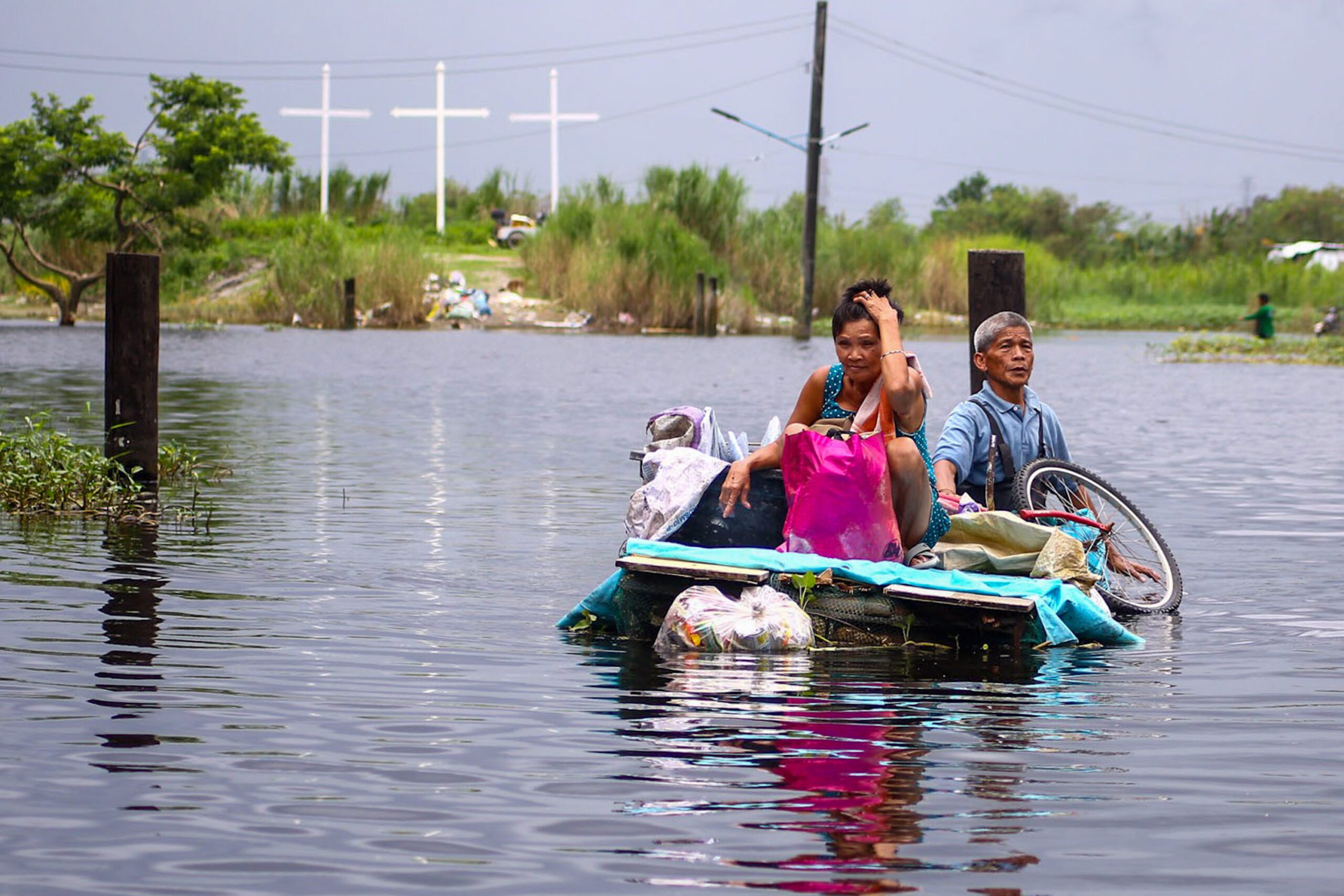
FLOOD. Residents of Barangay San Pedro Cutod, Pampanga, continue their daily lives while enduring floodwaters for nearly three weeks, caused by recent rains from the southwest monsoon, on September 7, 2026.
Rappler
In its latest submission to the United Nations, the Philippines underscores its high vulnerability to climate impacts despite minimal contribution to the crisis
AT A GLANCE
- The Philippines has committed to a 75% reduction in carbon emissions from 2025 to 2035, with 7% funded independently and 68% dependent on international support.
- The country aims to become a net sink for emissions during this period. It also highlights its vulnerability to climate impacts despite minimal contributions to the crisis.
This is AI-generated. Read the article for full context. Report any errors.
MANILA, Philippines – The Philippines has recommitted to a 75% reduction in carbon emissions, 7% of which the country would undertake and fund on its own, while the remaining 68% target is conditional upon international support.
These are emissions from sectors such as energy, transport, and agriculture covering the period of 2025 to 2035.
“With all identified policies and measures, the Philippines is projected, based on current analysis, to be a net sink over the 2025-2035 period,” the Philippines’ submission to the United Nations read. A net sink absorbs more emissions than it releases — like forests and oceans.
In its latest submission to the United Nations, the Philippines underscored its high vulnerability to climate impacts despite minimal contribution to the crisis. With this in mind, the Philippines set adaptation to severe impacts, such as massive flooding and heat, as a “central and continuous priority.”
Previously, the Philippines had committed to the same 75% target — the difference being that the targets that hinged on international support were bigger at 72.29%. The Climate Change Commission under the Office of the President leads the updating and submission of climate targets.
Whys and hows
Setting these climate targets, or the Nationally Determined Contributions (NDCs), is part of countries’ commitment to the Paris Agreement.
Reducing emissions is highly technical work that cuts across industries and sectors. But the objective is supposed to serve communities: decent work, social protection, and clean and sustainable livelihoods.
Under the Paris Agreement, countries voluntarily set their reduction targets based on capacity. It espouses a bottom-up approach, a revision from the previous international treaty that prescribed set targets for countries.
Parties to the agreement are required to update their NDCs every five years. The latest round of updates was due February 2025, but the Philippines wasn’t able to submit it by then. (READ: Philippines’ new climate targets won’t make it in time for COP30)
To finance its emissions reduction and green transition, the Philippines intends to “access and maximize broad sources of public and private finance.”
The financial support that relies on wealthier and industrialized countries “must be highly concessional, non-debt creating.”
Leaders and civil society representatives from developing nations continuously advocate for climate finance to be given as grants instead of loans. – Rappler.com
KioskNews shows a cleaned-up reading view extracted from the publisher’s page — the original always lives on their site, not ours.