Listening to the bush: how AI can help NZ rid its wilderness of ‘hold-out’ pest possums
Possums are among New Zealand’s most destructive introduced mammals. They damage native forests, prey on wildlife and remain a major target of the country’s Predator Free 2050 programme.
But removing most possums from an area through predator control is only part of the challenge. Finding the last few survivors can be much harder.
Even a handful of remaining animals can eventually rebuild a population, making it essential that conservation workers have effective tools to detect them.
One promising solution lies in microphones that record sounds overnight, combined with artificial intelligence (AI) software capable of scanning thousands of hours of audio for possum calls.
Our new research shows this approach can work well – but only if the AI learns not to mistake other animals for possums.
When AI hears possums that aren’t there
AI is becoming increasingly useful for analysing wildlife recordings, allowing vast amounts of audio to be processed automatically rather than requiring volunteers or researchers to listen to every recording.
This is particularly valuable during the final “mop-up” stage of eradication, when only a handful of animals remain and locating them can be challenging.
Many AI models can also run directly on small, battery-powered recording devices in remote forests, avoiding the need to upload huge amounts of audio for processing.
But there is a problem. AI models designed to run on low-power devices often produce more false alarms, wrongly attributing the calls of other animals to possums.
For conservation teams, a false alarm can mean travelling to remote locations in search of an animal that isn’t there. To tackle this problem, we developed a new training approach called “cross-model confusion mapping”.
Rather than asking the AI directly which sounds were possums, we first used BirdNET – a widely used AI system trained to identify more than 6,000 bird species.
Although BirdNET has never been trained to recognise possums, that proved to be an advantage. Because it could only classify sounds as birds, every possum call was forced into the bird species it most closely resembled. That revealed which bird species were most likely to be confused with possums.
To human ears, these calls sound quite different. But AI doesn’t “hear” sound the way we do. It analyses visual representations of sound frequencies over time, known as spectrograms, where the patterns are more alike than they seem to us.
We then added recordings of those birds into our training data as what we call “hard negatives” – examples the AI found difficult to distinguish from possums but needed to learn were not possums. The idea is similar to teaching someone to distinguish between two similar-looking people by repeatedly showing them examples of both.
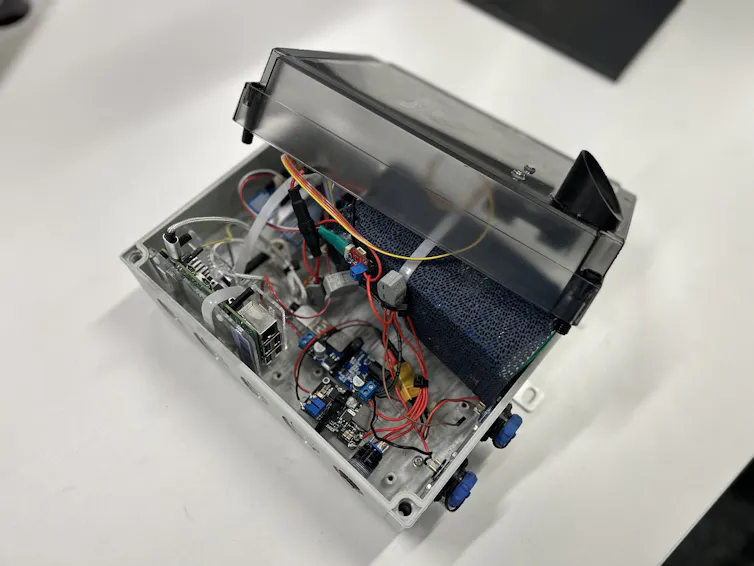
We then tested the retrained models using completely different recordings from native New Zealand forests, including natural forest sounds, bird calls, insects, rustling vegetation, wind, rain and possum vocalisations.
The results were encouraging.
Models trained using our approach produced far fewer false alarms while maintaining high detection accuracy.
By comparison, similar AI models trained without this targeted approach generated hundreds of false detections when analysing forest recordings that contained no possums at all.
Importantly, that difference only became apparent when the models were tested on recordings they had never encountered before. When evaluated using the same kinds of recordings they had been trained on, both approaches appeared to perform similarly.
Even more encouragingly, the approach also worked on forest recordings containing bird species the model had never encountered during training. This suggests it had learned to distinguish possum calls more generally rather than simply memorising a handful of confusing species.
A new tool for eradication?
That finding also highlights the importance of testing AI models on genuinely new, real-world data rather than only the examples they learned from.
While our work focused on possums, the same approach could potentially be adapted to detect stoats, rats and other invasive pest species that New Zealand is working to eliminate.
One notable omission was the ruru (morepork), New Zealand’s native owl. It wasn’t identified by BirdNET as one of the species most likely to be confused with possum calls, but understanding how the model performs around this important nocturnal species will be part of our future research.
Further field testing will be needed before the system can be widely deployed. But as bioacoustic monitoring becomes more common, AI could become an increasingly valuable conservation tool.
Finding the last remaining animals is often the hardest part of any eradication programme.
If AI can help conservation teams spend less time chasing false alarms and more time locating real pests, it could become another valuable tool supporting New Zealand’s Predator Free 2050 ambition.
KioskNews shows a cleaned-up reading view extracted from the publisher’s page — the original always lives on their site, not ours.