500 combat helmets on Sydney Harbour: This global artist-activist’s call for peace
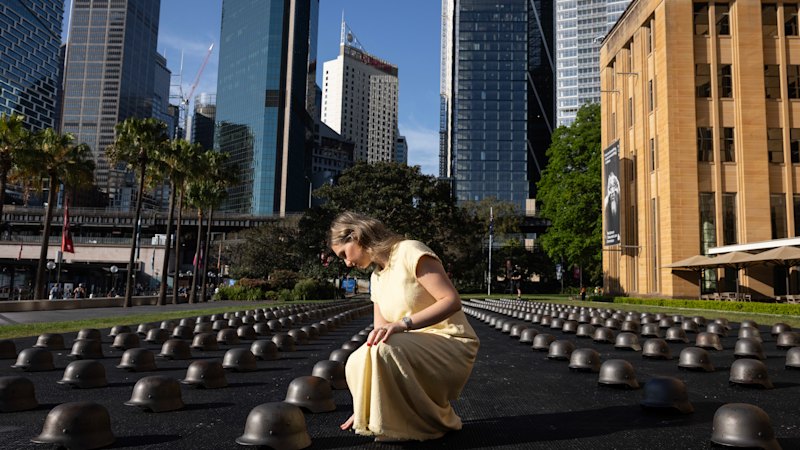
Five hundred cast-iron combat helmets have been arrayed on the lawn of the Museum of Contemporary Art Australia on Sydney’s harbour front by one of the world’s most influential artist-activists in an installation that functions as a sculpture and an urgent call for peace.
The sun rose on Friday on Ai Weiwei’s monumental, 40-metre work, titled Mushrooms, after the fence came down overnight on the public outdoor sculpture which aims to transform symbols of military protection into a collective declaration of peace and human resilience in a world the artist says is “filled with crises”.
The installation at Circular Quay is the second major public outdoor commission funded by a $3 million philanthropic gift from The Balnaves Foundation honouring the late Neil Balnaves, the television executive and philanthropist, which has since given a $32.5 million to arts organisations.
The first commission in the series was British artist’s Thomas J Price’s three-metre-tall golden bust of an “every woman” installed last year.
“In the era we live in, the 21st century, wars have not ceased,” says Ai, whose sculptures, photographs and public installations have long explored themes of political oppression, freedom of expression, and human rights abuses. “We continue to exist in a time where war and peace interchangeably assume each other’s roles, shaping the identity of our age. I hope this work prompts people to reflect on war and peace.”
Helmets are a recurring motif in Ai’s practice, first appearing in a series that replicated construction hard hats in fragile materials like marble and glass to honour miners lost in industrial disasters and workers who attempted to save victims of the 2008 Sichuan earthquake. In 2023, he created 90 porcelain helmets invoking World War II designs to reflect on the lives of soldiers and civilians caught in conflict.
The Sydney commission builds directly upon these themes, using 500 cast-iron sculptures and arranged in 10 uniform rows on an elevated metal and mesh platform bisected by a central walkway to allow the public to walk its aisles.
Each helmet weighs five kilograms and was produced in a Chinese foundry from a single mould, meticulously reproducing the original design’s interior cushioning.
The concept originated in response to the German government’s 2022 decision to donate 5000 helmets to Ukraine, a gesture widely mocked at the time as symbolic and inadequate for the realities of modern warfare.
The title Mushrooms operates on multiple levels, drawing on the biological ability of fungi to turn decay into new life, the ominous form of nuclear mushroom clouds, and a Chinese idiom suggesting endless bureaucratic delays. The project links to Ai’s decades-long focus on displacement and conflict, extending a legacy established by installations like the Tate Modern’s 2010 Turbine Hall commission of Sunflower Seeds.
In Australia, he is best remembered for his appearance at the 21st Biennale of Sydney in 2018 where Ai unveiled Law of the Journey, a massive black rubber lifeboat filled with figures of refugee, a commentary on the humanitarian disaster following the Syrian civil war and the global odyssey of displaced people. The artist also staged a silent vigil outside Julian Assange’s 2020 extradition hearing.
“This artwork can once again remind us that the world we inhabit is not a world free of worry. It is a world filled with crises,” he said via a video statement.
“At the same time, these crises generate political helplessness, and it is often this sense of helplessness that manifests itself in forms of criticality and humour. Together, they constitute an important dimension of our contemporary cultural reality.”
Hamish Balnaves said his father believed that art should be for the people, start conversations and show different perspectives.
“It is both timely and timeless and can talk to any time,” he said. “The inspiration for the work was about Germany’s gift of 5000 helmets to ukraine before the conflict happened, but it’s not a work about Ukraine specifically its about war and peace generally.
“When you look it is rows of helmets, and it does have a reflective element, and it does remind me of rows of crosses. It creates a human element towards something forgotten in modern warfare, and a lot of warfare from the air, that it does come down to individual lives.”
The non-acquisitive public sculptural commission series was partly inspired by New York’s The High Line, the park built on a freight train line, according to MCA director Suzanne Cotter.
“We’ve already invited a third sculptural commission, and they’re working on it, which will be completely different again,” she said. “It’s about telling a story about contemporary art and how artists work with the medium of sculpture.”
Alongside the installation, MCA Australia has launched Say Your Peace, a public program inviting visitors to record video messages to the artist.
Start the day with a summary of the day’s most important and interesting stories, analysis and insights. Sign up for our Morning Edition newsletter.
KioskNews shows a cleaned-up reading view extracted from the publisher’s page — the original always lives on their site, not ours.