Most Canadians oppose concessions as response to looming 50% U.S. tariffs: poll
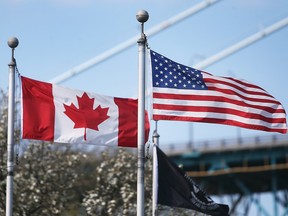
Canada is just days away from 50 per cent tariffs taking effect on hundreds of exports, after U.S. President Donald Trump signed an executive order last month invoking the never-before-used Section 338 of the Tariff Act of 1930.
Sign In or Create an Account
And Canadians are divided on what Ottawa’s response should be, with 36 per cent of respondents in an Abacus Data poll favouring counter-tariffs, even if they raise prices and risk escalation, compared to 30 per cent who want continued negotiations instead.
Meanwhile, just 18 per cent favour offering concessions to the United States, such as easing dairy restrictions or ending bans on American alcohol, even if doing so gets the tariffs removed.

Get a dash of perspective along with the trending news of the day in a very readable format.
By signing up you consent to receive the above newsletter from Postmedia Network Inc.
A welcome email is on its way. If you don't see it, please check your junk folder.
The next issue of NP Posted will soon be in your inbox.
We encountered an issue signing you up. Please try again
Abacus Data notes that these responses suggest the public “want the government to be firm, avoid escalation where possible, and get an agreement without appearing to give too much away.”
However, this point sees some differences across regions and political affiliation, with just 12 per cent of Quebecers open to concessions, compared to 23 per cent in Alberta. Only 16 per cent of Liberal supporters and 14 per cent of NDP supporters favour concessions, compared with 26 per cent of Conservatives.
The survey examined Canadians’ awareness of ongoing tariff negotiations with the U.S. and found that Canucks are paying close attention to the dispute, with 91 per cent of respondents saying they have seen, read or heard at least a little about the threatened 50 per cent tariffs.
Elsewhere, 55 per cent say Canada should prepare to move on from CUSMA and build trade relationships with other countries, compared with 34 per cent who want to keep working to preserve the agreement. That view is shared by 60 per cent of Liberal voters, compared to just 43 per cent of Conservative supporters who are prepared to move on.
Abacus Data says that this apparent openness to a future where Canada is less dependent on CUSMA gives Carney room to resist U.S. pressure.
National Post previously spoke to trade analysts about what Canada’s response to the 50 per cent tariffs should be and, much like the Canadian public, they were split on the best approach.
Lawrence Herman, senior fellow at the C.D. Howe Institute and a specialist in international trade and investment law, said he thinks a list of possible tariff countermeasures should have been produced immediately after Trump’s announcement last month.
“You maintain those tariffs and enact them on the 19th of August, here’s the list that we’re going to use for our counter-tariffs,” he offered as an example of how Ottawa should have responded to the threat.
However, Ed Fast, Canada’s former minister for international trade under PM Stephen Harper, cautioned against retaliation, urging negotiators to keep the economic asymmetry between the two countries front of mind.
“If we retaliate with tariffs, as some have suggested, the Americans are much better able to absorb that retaliation than we are to absorb their tariffs against us,” he said. “As more and more tariffs get levied, the more difficult it becomes for Canada.”
Meanwhile, three senior federal or provincial government sources recently told National Post that despite frequent meetings between the Canadian and American negotiating teams, the two camps are “not even close” to making a deal.
Now, the sources say, the Canadian side is refocusing its efforts to find an “interim” deal to prevent sweeping new tariffs on Aug. 19.
That said, the Abacus Data poll found that Canadians aren’t convinced this latest round of tariffs will actually take effect, with 40 per cent of respondents putting the odds at 50/50, compared to 38 per cent who believe they will happen and just 10 per cent who think they are unlikely or definitely will not happen.
Despite this uncertainty, Canadians overwhelmingly expect negative consequences of new tariffs, with 70 per cent believing they would have a negative impact on the economy in their area, including 29 per cent who expect a very negative impact.
This view crosses regional lines, with 75 per cent in Quebec expecting a negative effect, along with 74 per cent in B.C. and Alberta, 68 per cent in Ontario, 65 per cent in Saskatchewan and Manitoba, and 58 per cent in Atlantic Canada. Overall, just nine per cent expect a positive impact.
Meanwhile, 74 per cent say the ongoing trade war over the past year and a half has had an impact on their household, including 30 per cent who describe the impact as major, a finding that remains consistent across regions and age groups.
The Abacus Data poll was conducted with 1,499 Canadians from August 7 to 12, 2026. The margin of error for a comparable probability-based random sample of the same size is plus or minus 2.5 percentage points, 19 times out of 20.
Our website is the place for the latest breaking news, exclusive scoops, longreads and provocative commentary. Please bookmark nationalpost.com and sign up for our daily newsletter, Posted, here.
Join the Conversation
This website uses cookies to personalize your content (including ads), and allows us to analyze our traffic. Read more about cookies here. By continuing to use our site, you agree to our Terms of Use and Privacy Policy.
KioskNews shows a cleaned-up reading view extracted from the publisher’s page — the original always lives on their site, not ours.