Kelly McParland: After years of costly climate policies fail to meet targets, UN advocates for more
I was awakened the other day by a noisy hubbub on the street outside.
Sign In or Create an Account
It proved to be two men in a municipal vehicle, racing around the neighbourhood digging holes and planting leafless sticks in front yards. The sticks were allegedly trees, part of the local government’s program against climate change. If they survived the winter, they were to provide “town-wide cover” to absorb emissions and save us from an inferno-esque future.
Not long afterward, a report arrived detailing further civic exertions on the climate’s behalf. Only, at the end, it noted the local government’s own emissions were up 8 per cent thanks partly to the fact it was still cutting grass with gas-powered mowers and deploying emission-spewing trucks to scatter saplings like dandelion seeds.

Columnist Jesse Kline keeps you up to date with what’s happening in Israel and the effects of antisemitism on life here in Canada. Friday mornings.
By signing up you consent to receive the above newsletter from Postmedia Network Inc.
A welcome email is on its way. If you don't see it, please check your junk folder.
The next issue of Channel Israel will soon be in your inbox.
We encountered an issue signing you up. Please try again
I mention this as an example of the decades of ill-considered, poorly planned, under-researched, often contradictory and frequently doomed government schemes imposed in the name of “climate action” prior to this week’s announcement that one of the world’s foremost initiatives was officially a failure.
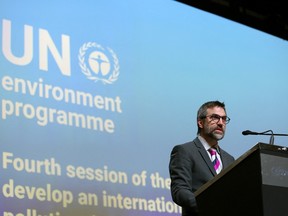
Last week, the United Nations Environment Programme published a report conceding that the world had missed its opportunity to meet the 2015 Paris Agreement‘s goal of limiting the increase of global temperatures to 1.5C. The only hope of reversing the overshoot appears to be doubling down on the ambitious strategies that have proven inadequate.
“Decades of insufficient climate action” have put success beyond reach, it said, admitting a breach of the limit has become “inevitable.” Even if every country met its Paris pledges, which many including Canada won’t, goals set for 2030 and 2035 won’t be met. Should new and tougher cuts be approved, it could still take until 2100 to succeed.
The report received muted attention in much of the mainstream media, perhaps reflecting the fact it’s been a long time since anyone seriously expected the world to deliver what climate chieftains asked of it.
It’s a shame Earth’s eight billion people couldn’t be mobilized into altering their lives enough to offset the damage they were doing to the planet, but they’re not the ones to blame for the failure. Ordinary people have made enormous efforts to contribute what they could. The shortfall results from a formula that pitted activists, experts, governments and climate evangelists against the practical realities of everyday life. Politicians spouting utopian scenarios ran into a wall of human limitations, unable to deliver the revolution asked of them.
It was never going to work — could a world that wouldn’t unite to defeat poverty or hunger really band together over the weather? Even so, doubters were denounced as cranks and deniers.
Lord knows how many billions or trillions went into the outpouring of schemes that followed including battery plants that didn’t open, windmill blades that couldn’t be sold, ad campaigns to bolster corporate and government images without measurable results and global summits reached by private jet and limousine, inside air-conditioned hotels filled by thousands of posturing politicians.
All with the best intentions, of course, but a blind eye to potential consequences. Germany proudly shuttered its nuclear plants in favour of cheap gas purchased from Russia, which used the money to help finance its brutal assault on Ukraine. Now, Berlin is scouring the globe for supplies of liquified natural gas to replace the Russian gas that’s blocked by sanctions. Britain put a curb on North Sea oil and gas while betting on wind farms, only to change course last week under a left-wing Labour government that needs the money for a social program offering free cars for recipients who surrender a share of their welfare benefits.
From the day it was approved, the Paris Agreement set off overcooked aspirations that couldn’t be satisfied outside the remaking of much of the planet. Ambitious reforms that seemed sensible to a clutch of wealthy western countries were like messages from Mars in developing countries still transfixed by efforts to rise from generations of poverty.
Canadians could swear off gasoline-powered leaf blowers, buy a battery-charged model instead and feel good about themselves, but how were the 340 million Indians who live on $4.20 a day — equal to the entire U.S. population — supposed to switch off wood, coal or whatever else they could burn as they fought just to survive?
To lift much of Africa and Asia out of such depths would require vast subsidies from the world’s richer countries, none of which were willing to pay given the political risk, the certainty of a voter backlash and the restraints on economies already mired in decades of debt.
Of all the countries that signed the document, China best mastered the art of having it both ways. It built coal plants and windmills with equal alacrity, insisting on its status as a developing country deserving of subsidies and extended deadlines, while simultaneously building the world’s second biggest economy. China plead poverty while offering extravagant loans to more destitute nations in return for a chunk of their economies.
What were people to make of the discrepancies between oratory and action? Canada was no slouch when it came to mixed signals. Former prime minister Justin Trudeau handed the environmental portfolio to Radical 1 and Radical 2, Catherine McKenna and Steven Guilbeault, providing them a megaphone to lecture Canadians while Trudeau spent $34 billion on a pipeline to ensure Alberta could ship more oil to ready customers. Ontario signed a deal pledging billions to South Korean firms to help create an alternative energy superpower, then discovered it didn’t need extra power and dumped surpluses at a bargain prices.
Ontario and Quebec both directed billions to firms dangling dreams of battery plants just as the auto industry was heading towards a cliff. Mark Carney wrote a book on environmental values then cancelled several of Trudeau’s efforts when he became prime minister and agreed to buy cars from China, which remains the largest single emitter by a healthy margin.
Canada’s delegation to Paris numbered 283, but Ottawa failed to meet its own targets. The Paris pact has not been without successes: the alternative energy industry has grown substantially and EV business has flourished, though mostly to the benefit of Chinese firms able to produce cheaper vehicles thanks to low wages, long working hours and government funding, enabling it to flood markets at the expense of domestic manufacturers.
Germany’s Volkswagen is cutting 100,000 jobs. Last year, it closed a production plant for the first time in its history. Meanwhile, sales of Chinese brand vehicles exported to European countries grew from 2 per cent to 9 percent in four years, shifting their automotive trade balance with China into deficit.
Politics and reality are two different things. A world that lives by the fantasies of politicians and activists is dabbling with disaster. Good intentions won’t make wildfires go away and attacking those who suggest otherwise doesn’t win the argument. The United Nations will probably go ahead with its annual climate summit, the 31st of its kind, scheduled for Turkey in November. The usual thousands will congregate making the same old speeches. But don’t expect a different result as long as quixotic dreams fill the agenda.
National Post
Join the Conversation
This website uses cookies to personalize your content (including ads), and allows us to analyze our traffic. Read more about cookies here. By continuing to use our site, you agree to our Terms of Use and Privacy Policy.
KioskNews shows a cleaned-up reading view extracted from the publisher’s page — the original always lives on their site, not ours.