Israel election: Israelis vote for 1st time since October 7 terror attack
What you need to know
- Israelis voting to elect Knesset
- Benjamin Netanyahu, Israel's longest-serving prime minister, faces a staunch challenge to his grip on power
- His chief rival is former military chief Gadi Eisenkot
- Eisenkot's Yashar party has polled higher than Netanyahu's Likud party
- Arab parties are projected to play kingmaker in post-election coalition talks
- This is the first election since the 2023 October 7 Hamas-led terror attack and the subsequent two-year Gaza war
Follow below for all the latest on the Israeli election on October 27, 2026, and its aftermath:
Skip next section Polls open in Israel electionPublished October 27, 2026last updated October 27, 2026
Polls open in Israel election

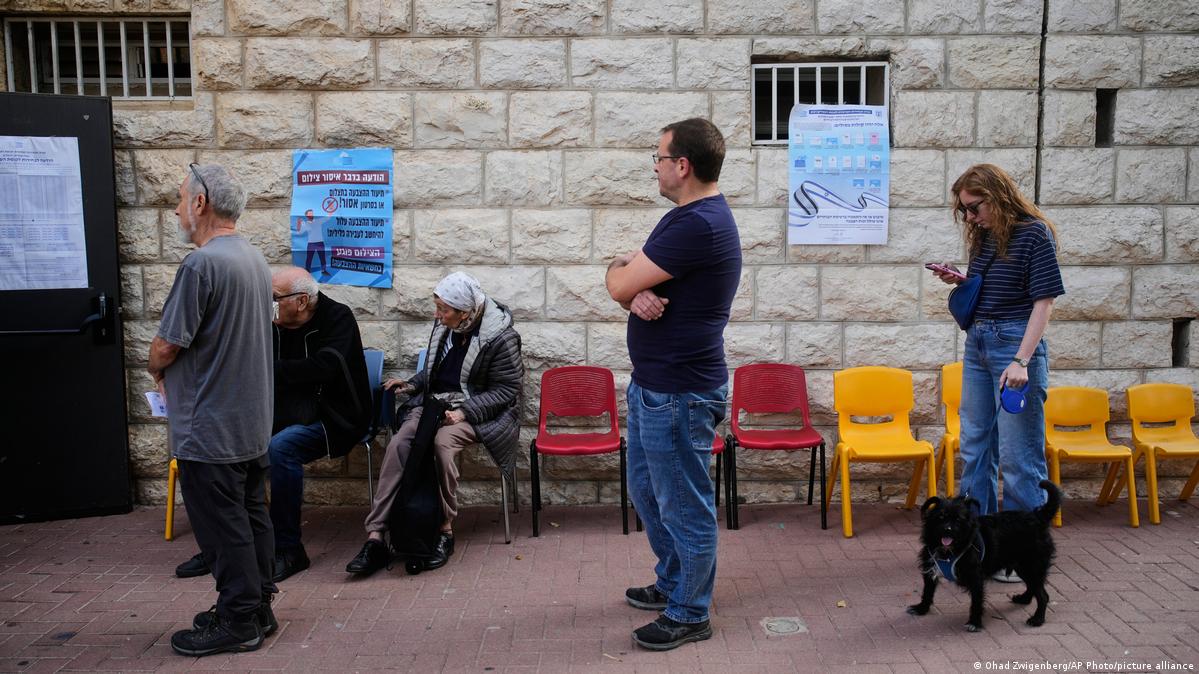
Voting began in Israel at 7 a.m. local time (6 a.m. CET) on Tuesday in the first general election since the deadly Hamas attack on October 7, 2023, and the devastating war in Gaza unleashed by Israel in response.
Some 7.3 million Israeli citizens are eligible to vote, with polls showing right-wing Prime Minister Benjamin Netanyahu, the country's longest-serving premier, neck and neck with his main centrist rival Gadi Eisenkot.
Most polling stations will close at 10 p.m. (9 p.m. CET).
https://p.dw.com/p/5OiJj
Skip next section WATCH: Netanyahu's final campaign? — Israel heads to the pollsOctober 27, 2026
WATCH: Netanyahu's final campaign? — Israel heads to the polls
Emily Gordine
There's a lot at stake in this election: The fallout and questions of political accountability for the attacks of October 7, 2023; mandatory military service for ultra-Orthodox men and sharing the burden of national defense; along with Israel's standing in the international community.
Nowhere can the division within Israeli society be more felt than in debate over Benjamin Netanyahu.
For the past four years, Israel's long-standing prime minister has led what has been described as the most right-wing government in the country's history. He broke with political convention by forming an alliance with ultranationalist politician Itamar Ben-Gvir.
Many Israelis want to see an end to this government. They blame it for the failures surrounding Hamas' terror attack and for the country's growing isolation internationally. Many are placing their hopes in Gadi Eisenkot, who has emerged as a leading opposition figure to challenge Netanyahu.
Netanyahu's final campaign? — Israel heads to the polls
https://p.dw.com/p/5OTcf
Skip next section Security fears and domestic divides define Israel's election battleOctober 27, 2026
Security fears and domestic divides define Israel's election battle
Israeli Prime Minister Benjamin Netanyahu and his top challenger Gadi Eisenkot are both against the creation of an independent Palestinian state, meaning the election is not expected to lead to major policy changes that could revive the long-stalled peace process.
Here are some of the other major campaign issues:
- Security and the War: Voters are focused on the management of the Israel-Hamas war, the future of Gaza, and handling threats from Iran and Hezbollah.
- Military Service: There is an intense debate over whether the exemption for ultra-Orthodox (Haredi) men should be extended or whether they should be required to serve in the military like other Jewish citizens.
- The Justice System: There are deep disagreements over proposed judicial reforms that would change the balance of power between elected politicians and the Supreme Court.
- The Economy: Voters are highly concerned about the cost of living, housing prices, inflation, and war-related spending, although these are not the primary campaign issues.
https://p.dw.com/p/5ObQp
Skip next section Welcome to our coverageOctober 27, 2026
Welcome to our coverage
Israelis head to the polls today to elect a new Knesset in what is expected to be a tightly contested race.
Incumbent Benjamin Netanyahu, the country's longest-serving prime minister, is fighting to stay in power, with several court cases awaiting him if he loses office.
Polls suggest his opponent, former military chief Gadi Eisenkot, is in the lead.
Stay tuned as we closely follow the election, its results and the wider implications for the region.
KioskNews shows a cleaned-up reading view extracted from the publisher’s page — the original always lives on their site, not ours.