Sugar stakeholders agree to form panel vs RSSI infestation
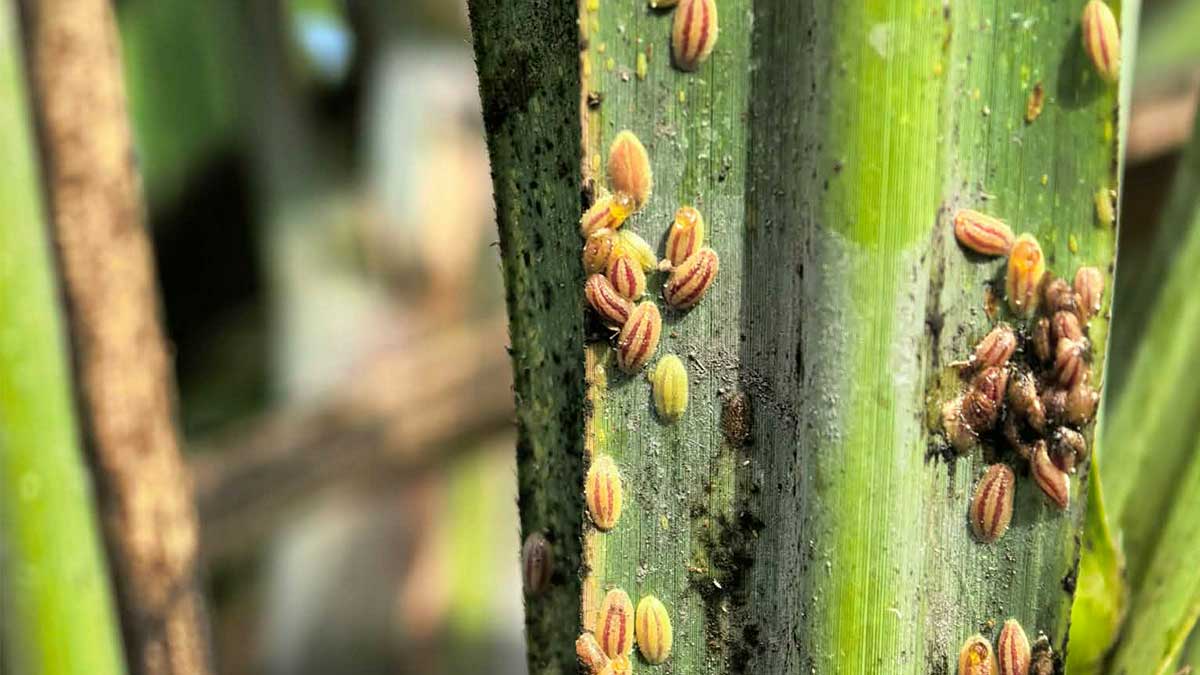

BACOLOD CITY — Sugar industry stakeholders have agreed to form a national ad hoc committee to coordinate the government’s response to the worsening infestation of the Red Striped Soft Shell Insect (RSSI), a labor leader said.
Roland de la Cruz, president of the National Congress of Unions in the Sugar Industry of the Philippines (NACUSIP), said the proposal was agreed upon during First Lady Liza Araneta Marcos’ meeting with sugar industry stakeholders in Bacolod City on Aug. 14.
The committee would adopt a whole-of-government approach to address the infestation, strengthen diagnostics, and ensure timely and transparent interventions, de la Cruz said.
Article continues after this advertisement
He noted that the infestation had severely affected hundreds of thousands of sugar farmers, workers, and agrarian reform beneficiaries (ARBs) nationwide.
FEATURED STORIES
NEWSINFO
NEWSINFO
NEWSINFO
The proposed committee would coordinate scientific and field interventions among the Department of Agriculture, Sugar Regulatory Administration (SRA), other government agencies, local governments, and Congress.
It would also strengthen early detection and rapid response, promote accountability in assistance programs, and support legislative reforms for the sugar industry.
READ: Negros sprays biocontrol fungi on RSSI-hit sugarcane plantations
Farmers seek clear guidelines
Elisama Gregorio, chairperson of the NACUSIP Agrarian Reform Beneficiaries Council, said farmers urgently need clear, science-based SRA guidelines on managing RSSI.
Article continues after this advertisement
In the absence of official guidance, farmers have relied on social media for information on pesticide use, spraying, quarantine, and containment measures, she said.
“Farmers are left to guess their way through this crisis. Without clear guidelines, they rely on social media posts instead of science. This is unacceptable for an infestation of this scale,” Gregorio said.
Article continues after this advertisement
Anthony John Demisana, general secretary of the ARB Council, criticized the SRA for inadequate grassroots consultation in distributing machinery, farm implements, and fertilizer.
He said some equipment was sent to upland farms where it could not be properly used, while fertilizer arrived weeks before harvest.
“Assistance must be based on real conditions in the field. Without grassroots consultation, resources are wasted and farmers continue to suffer,” Demisana said.
READ: Biospraying vs sugarcane pest starts in Negros Occidental
Calls for relief
Stakeholders also sought grant-based assistance, loan moratoriums, and penalty condonation for farmers affected by RSSI and falling sugar prices.
Benjie de la Cruz, executive vice president of the Congress of Independent Organizations-CIO UNI, called for a moratorium on loan payments and the condonation of penalties and interest for affected farmers, ARBs, cooperatives, and associations.
Deputy Speaker Albee Benitez urged the Land Bank of the Philippines to provide grants instead of additional loans.
“Our farmers need relief, not additional burdens. Grants will allow them to recover and continue producing,” Benitez said.
De la Cruz also called for broader representation of workers, farmers, and ARBs on the Sugar Board, noting that ARB farms account for about 80% of sugar production but lack representation.
He cited the proposed T.U.B.O. Bill, filed by Rep. Javier Miguel Benitez and Deputy Speaker Raymond Democrito Mendoza, which seeks to expand Sugar Board membership.
Your subscription could not be saved. Please try again.
Your subscription has been successful.
De la Cruz said sugar workers, ARBs, and farmers’ groups appreciated Marcos’ decision to meet with industry stakeholders and discuss the RSSI crisis. /mcm
KioskNews shows a cleaned-up reading view extracted from the publisher’s page — the original always lives on their site, not ours.