B'luru traffic is stealing 53 days from schoolchildren every year: How it came to this
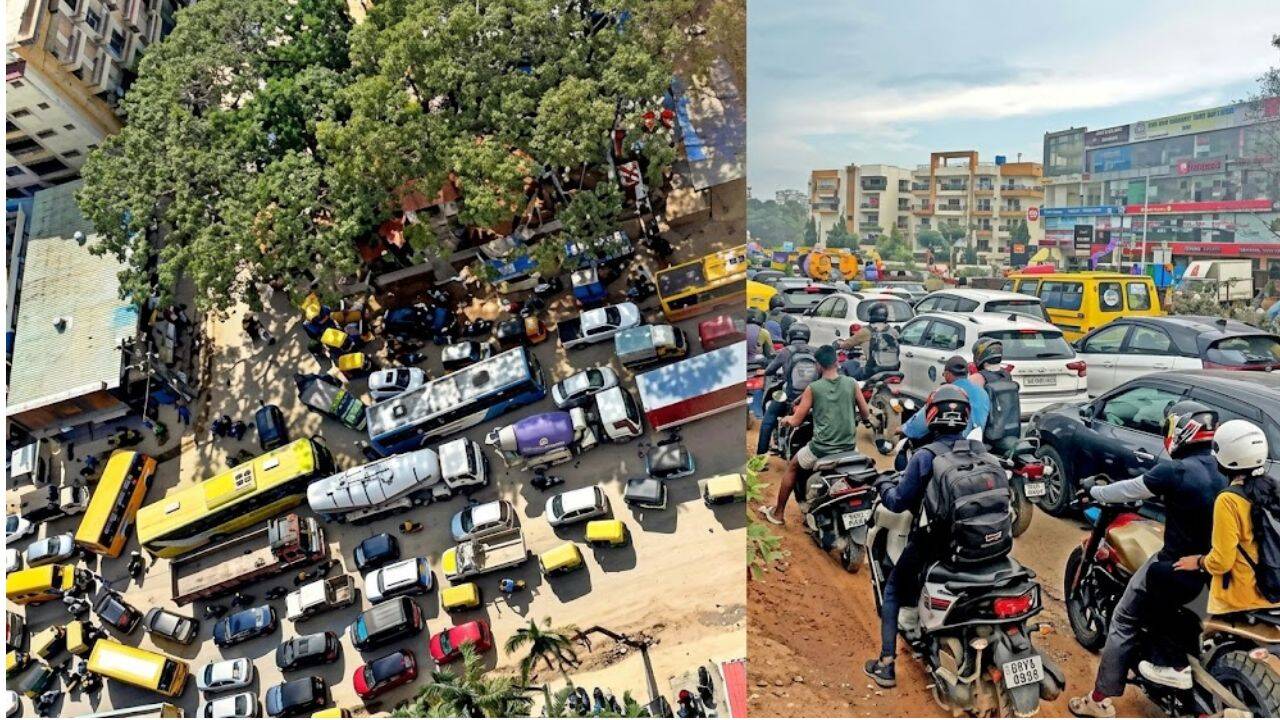
Traffic flow improved with police enforcement, heavy-vehicle curbs, but bottlenecks remained due to patchy repairs and narrow stretches.
BENGALURU: For 40,000 schoolchildren and their parents, the school commute to and fro through east Bengaluru is no longer a commute. It is becoming a big part of their school day.
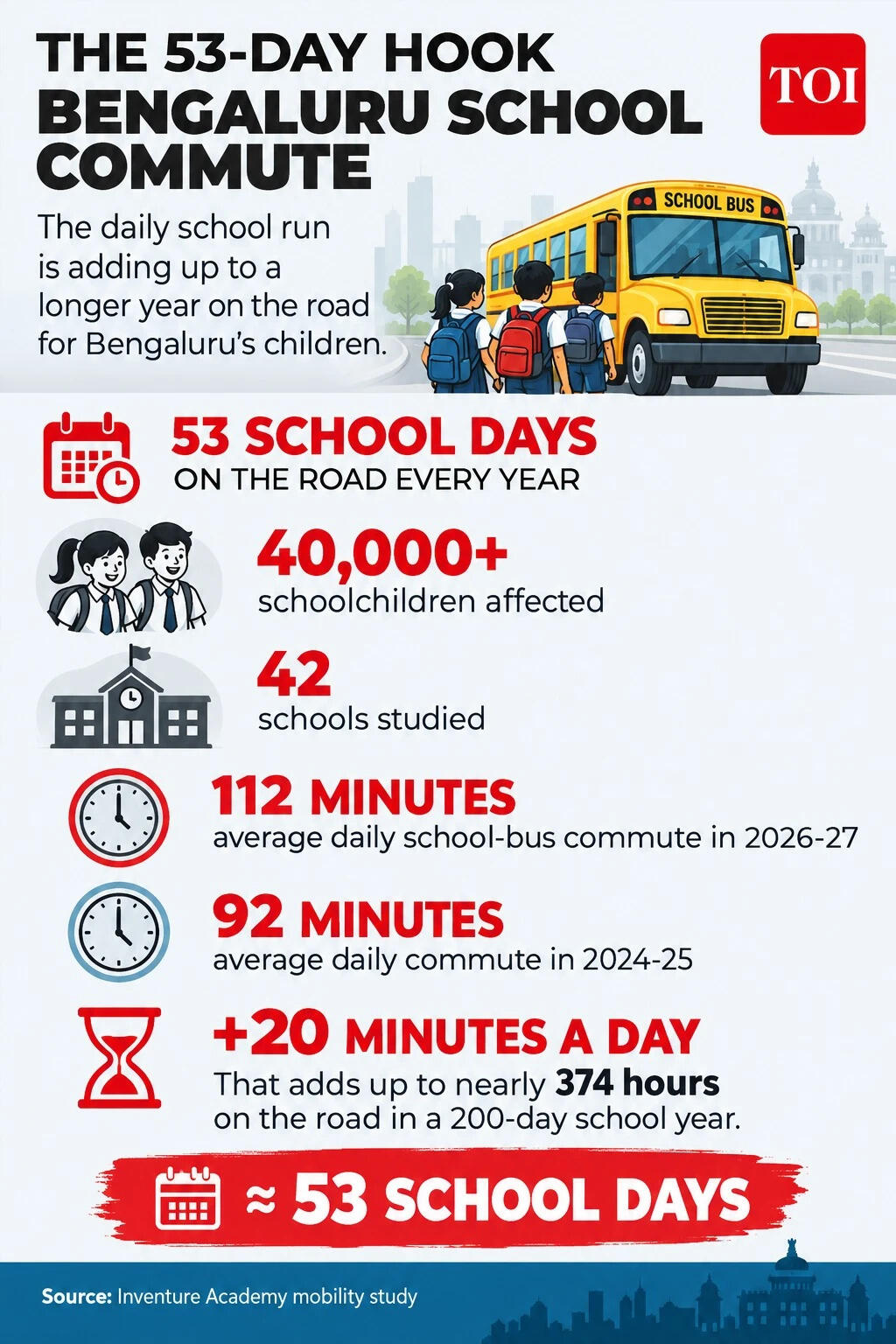
Children spent nearly 53 school days on roads
A recent mobility study by Inventure Academy of 42 schools along the state highway-35 corridor revealed that the average school-bus travel time has increased to 112 minutes in 2026-27 from 92 minutes in 2024-25.
That adds up to about 374 hours on the road in a 200-day school year – or nearly 53 school days spent on the road.
Buses took 2.5 hours for just four kilometres
92 minutes to 112 minutesThe numbers illustrate how rapidly the situation has spiraled. Average daily bus commute has increased by about 22% in two academic years. GPS data from 61 school buses shows that average speeds on the corridor dipped to 9.2kmph, with some patches recording as low as 6.4 kmph. On the worst days, the situation is even worse.
In September, school buses took up to 2.5 hours to cover just 4km on the Varthur-Gunjur stretch, leaving students late for exams.
How traffic crisis is eating into students’ school time
The problem is especially severe during school hours when multiple choke points happen at the same time. The Varthur-Gunjur-Dommasandra corridor is a mix of schools, residential layouts, IT offices and construction activity, which brings thousands of vehicles on to roads not meant for today’s volumes.
Parents have reported buses taking over two hours to travel just a few kilometers, while the study found about 60 per cent of school-bus trips do not arrive at their destinations on time.
The evening return leg is often worse, with afternoon speeds decreasing.East Bengaluru outran its roadsBengaluru’s growth story is also the story of traffic crisis. Rapid growth in housing, schools and employment have been seen in areas like Varthur, Gunjur, Dommasandra, Whitefield and nearby places in the technology corridor.
But the capacity of the roads and their supporting infrastructure have not kept pace.The SH-35 corridor itself has been identified as a heavily congested arterial and road widening and an elevated corridor has been planned to alleviate some of the bottlenecks. The ongoing project plans to widen parts of the road considerably but land acquisition, utility diversion and delays in execution have slowed the work.The overpass was meant to be part of the solutionThis is where the infrastructure timeline is hard to ignore.
Varthur elevated corridor construction started in May 2019. It was to be completed by November 2021.Seven years later, the project is still not at the finish line. KRDCL has now set December 2026 as the latest target for the completion of the Rs 488-crore project after delays due to land acquisition, right-of-way issues, utility shifting, approvals and execution. The study pegged the project at roughly 12% complete, highlighting the gap between the planned infrastructure of the corridor and the reality for commuters today.Why Metro cannot solve this particular problem aloneThe Varthur traffic story also has a bigger lesson: Bengaluru’s mobility problem cannot be solved by one infrastructure project. Earlier, residents of Varthur had argued that mass transit including Metro connectivity would be a better option for the ever-growing population than just a flyover.The city's Blue Line expansion and other Metro projects are under way, but much of the daily school commute along SH-35 remains reliant on roads and school buses.
A Metro network can move masses of commuters but it cannot clear the bottlenecks around schools, junctions and incomplete roads.The quick fixThe recent reaction suggests that some relief need not wait until the completion of a major project. In the aftermath of the traffic outrage, Bengaluru development minister Krishna Byre Gowda has asked officials to prioritize pothole repairs and address delays in road works.Restrictions on heavy vehicles during school hours have also been imposed by authorities. A later ground report found that traffic flow was better with police enforcement and restrictions on heavy vehicles, but there were still bottlenecks due to patchy repairs and narrow stretches.So the 53-day number is more than a stunning statistic. It illustrates the effect of a city’s residential and employment growth outpacing its transport infrastructure. For the children who travel through Varthur, Gunjur and Dommasandra the cost is not just in minutes lost in traffic, but in time taken away from school, play, rest and family. The bigger question for Bengaluru is if its next phase of growth is delivered with infrastructure before the traffic crisis hits the next generation.
KioskNews shows a cleaned-up reading view extracted from the publisher’s page — the original always lives on their site, not ours.