Israel picks state-backed funds to drive investment in next-generation defense tech
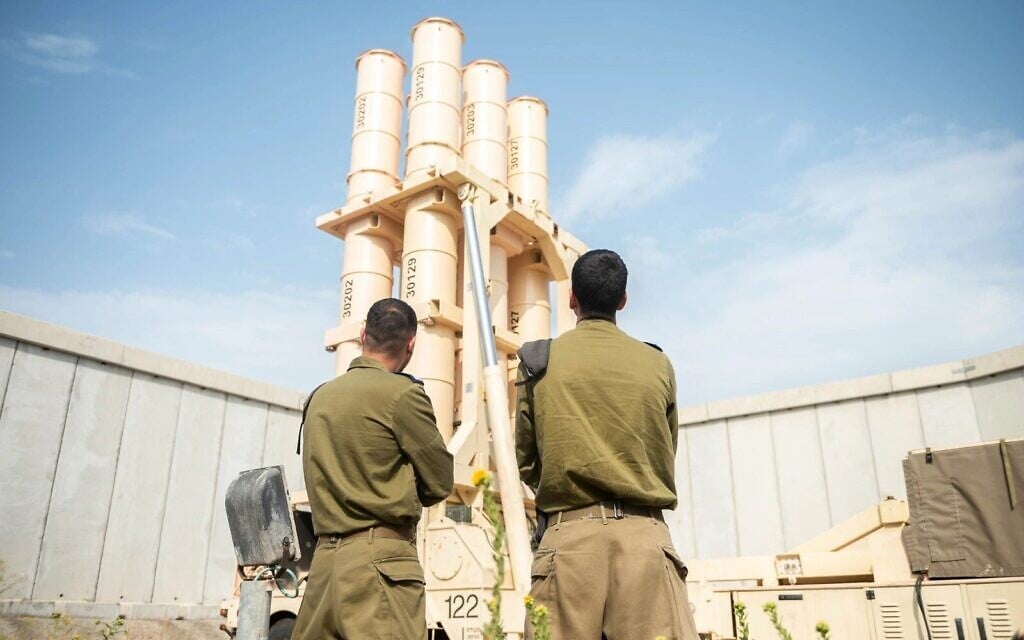
Israel is backing two venture capital funds through state guarantees to nurture the next generation of local advanced defense technologies and strengthen the country’s security independence and tactical superiority on the battlefield.
Following a bidding process, the Finance Ministry, along with the Defense Ministry’s Directorate of Defense Research and Development (DDR&D), selected venture capital funds Adir Capital and Sling Capital to unlock private investment in critical military and dual-use technologies and help cement Israel’s position as a global hub for defense innovation.
The initiative comes as NATO members pledged last year to ramp up defense-related spending to five percent of GDP, and as some European governments are canceling arms deals with major Israeli defense contractors and are seeking sanctions on Jerusalem due to the war against the Hamas terror group in Gaza.
0:00 / 0:00
Promoted: Theatron Hotel and Residences

“The establishment of the funds marks a central milestone in the Defense Ministry’s strategy to transform the unique Israeli ecosystem — connecting the Defense Ministry and the IDF with defense industries and local entrepreneurship — into a global leader in the defense tech industry,” said Defense Ministry Director General Amir Baram.
As part of the initiative Adir Capital, managed by Idan Financial Instruments, and Sling Capital, led by Giza Venture Capital, the winners of the tender, will each receive NIS 100 million ($33 million) in state guarantees. Adir has recruited Maj. Gen. (res.) Mishel Yanko as chairman of the state-backed fund and IDF veteran Maj. Gen. (res.) Yaakov Ayish as a strategic adviser. Yanko previously served as head of the IDF Technology and Logistics Directorate during the Israel-Hamas war.
Sign up for the Tech Israel Daily and never miss Israel's top tech stories
By signing up, you agree to the terms
State guarantees protect investors against the risk of losses and serve as incentives to encourage investment in new advanced defense technologies, which are considered high-risk.

The joint initiative aims to bridge the gap between the current shortage of private capital and funds available for high-risk defense sectors and the growing need for military innovation as underlined by Israel’s multifront conflicts and in light of emerging geopolitical risks.
The war with Hamas, which broke out with the terror group’s October 7, 2023, attack on southern communities in Israel, has fueled the growth of defense tech startups, often led by reservists returning from the battlefield. The pressing security needs of a rapidly changing battlefield have sparked the need for entrepreneurial ventures developing autonomous defense systems at startup speed that can be deployed and replaced in months rather than years.
“After three years of war, we must increase investment in research and development to maintain the qualitative-strategic edge of the defense establishment and support the development of the next generation of technological ‘surprises,'” said Baram.
The initiative is built on a model similar to the Yozma program, which the government set up in the 1990s to create a local venture fund industry that invested in burgeoning Israeli technologies and helped turn the country into a startup cyber nation.
Accountant General Michal Abadi-Boiangiu said that state-guaranteed funds are a central and strategic tool for encouraging new growth engines in the economy.
Over the next six to 12 months, the two selected funds are expected to raise at least $150 million each. The state support is expected to attract local and international interest, and is hoped to help raise a maximum of $300 million to $350 million in capital for each investment fund.

Half of the state-guaranteed funds will be invested in purely defense-related Israeli companies that do not operate in dual-use fields, meaning areas that are both military and civilian. The screening of the companies will be performed together with the DDR&D, known in Hebrew as Mafat, to match the country’s military technology needs. The battle-tested technologies will serve national defense needs and will also marketed outside Israel in collaboration with Mafat.
The vision is to create a national ecosystem for the development of entrepreneurship and innovation, which will help ensure supply chains of critical military components and domestic production and contribute to job creation and economic growth in the country.
The focus areas of investment include weapons components, drones, cost-effective autonomous systems, strategic electronic warfare navigation systems, and supply-chain dual-use technologies. About 20% of the capital that Adir will raise will be invested in early-stage companies and 80% in growth companies that already have a proven defense-related technology and a product with a market fit.
For the past decades, Israel’s defense industry has been dominated by a handful of major companies, including Rafael Advanced Defense Systems, Israel Aerospace Industries (IAI), and Elbit Systems. The large defense contractors have worked closely with the government, securing long-term procurement deals and developing proprietary technologies.
Israel is home to more than 334 defense tech-related startups and firms, according to data collated by Startup Nation Central. The startups and firms operate across aerospace, defense, and homeland security (HLS) technologies, as well as autonomous systems, cyberdefense, AI, and robotics.
Help us report truthfully on social media

As a multimedia journalist, my job is to take the quality, fact-based journalism produced by The Times of Israel newsroom and make it accessible across every platform — from Instagram posts to podcasts to short-form videos.
This is how many, especially young people, consume news these days. But misinformation is rampant on social media. Our team at ToI produces accurate, responsible short-form reporting on Israel and the Jewish world.
If you believe in the importance of factual social media journalism, please consider joining our reader support group, The Times of Israel Community. Your financial support is essential to sustain responsible multimedia reporting.
— Gabriella Jacobs, multimedia journalist
Support our work Support our work Already a member? Sign in to stop seeing this
KioskNews shows a cleaned-up reading view extracted from the publisher’s page — the original always lives on their site, not ours.