Naftali Bennett’s reset: Why the former PM broke his promises - and his plan to 'repair' Israel
"My name is Jimmy Carter, and I’m running for president of the United States.”
That was how Carter, a little-known peanut farmer and former Georgia governor, introduced himself to voters while campaigning in 1976 for the highest office in the land.
Naftali Bennett seems to be taking a page out of Carter’s campaign playbook.
Granted, Bennett – who already served a short stint as Israel’s prime minister – is well known in the country. But, like Carter, he is traversing the width and breadth of the land, talking to “regular people” in informal street-corner “parliaments.”
While Carter introduced himself to the American people, Bennett is trying to reintroduce himself to the Israeli public – especially right-wing voters who feel that, after he formed a government with Ra’am’s Mansour Abbas and Yesh Atid’s Yair Lapid in 2021, they no longer really know him.

In a video clip posted on Bennett’s Facebook page, a man named Yankele describes, at one such “parliament” in Beersheba, how betrayed he felt by Bennett, for whom he had previously voted.
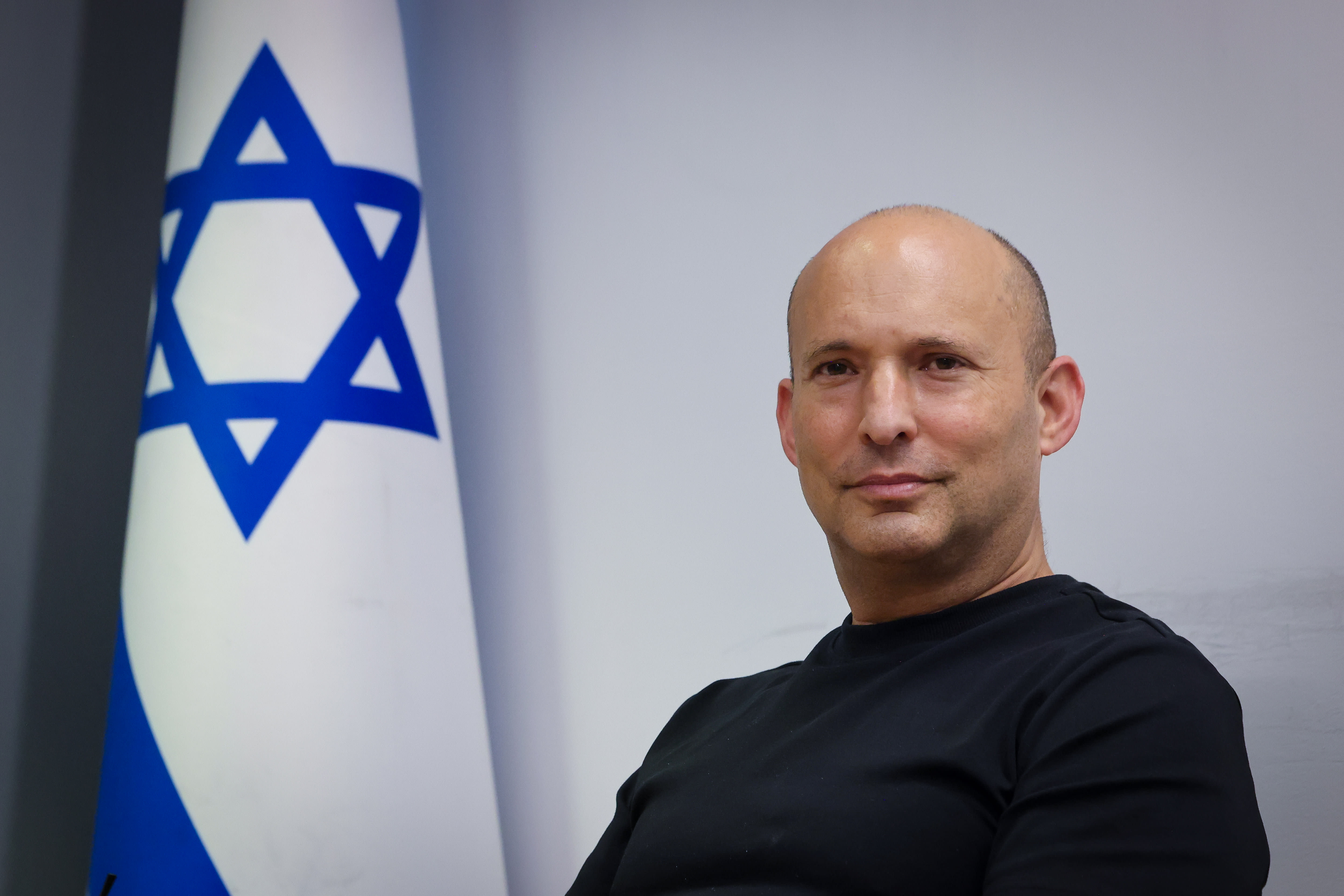
“Do you know why the hurt was so great?” he said, as a black-T-shirted Bennett sat and listened. “Because we know that you come from us – from our camp, from our ideology – and because, excuse me, you turned your back on ideology for a job.”
Bennett’s “parliaments” are punctuated – as in the Knesset – by hecklers yelling “liar” and “traitor.” He told Yankele that he was not going to try to convince him that he had been right but rather explain his motivations. Bennett finds himself doing that over and over, hoping – as Carter did – that one conversation at a time can change the way voters see him.
“I JUST come in, sit, have coffee, and they start cursing,” Bennett said this week during an hour-long interview with The Jerusalem Post, describing these encounters.
“It’s tough, but you know what? I learn a lot. First of all, I listen. I agree with some of the criticism, which is just, and then I try and unpack– and it’s working.”
Asked which criticism he accepts, Bennett replied, “That I broke a promise. Yeah, and they feel that I zigzagged.”
That broken promise – to refrain from joining a government with Abbas – has dogged Bennett ever since among the right-wing camp from which he emerged and of which he still considers himself a part. He once served as director-general of the Yesha Council, remains adamantly opposed to a Palestinian state, and supports settlement in Judea and Samaria.
“I did break a promise. That’s just a fact. Unfortunately, I had promised not to form a government with Abbas, and I did. I can’t change history, but I stand behind that decision, and I explain why I made that decision.”
His 30-second explanation can be boiled down to this: After four elections, Bennett gave Netanyahu his party’s seven seats following the 2021 vote, but Netanyahu still had only 59 mandates. Netanyahu then sought Abbas’s support and, according to Bennett, persuaded nearly everyone in the right-wing bloc – including the haredi parties and Itamar Ben-Gvir – to accept the idea. Religious Zionist Party head Bezalel Smotrich refused, however, and the effort collapsed.
Bennett said he ultimately faced a choice: “I had an option to go to fifth, sixth, seventh elections and tear Israel apart, but I will have met my promise, or do the right thing for Israel, which I thought was to form a government – which would be a good government – and try and pull Israel out of the hole, and that’s what I did.
“I think even my detractors agreed that it was a competent, effective government,” he said. “It didn’t last long because of the coalition, but we got stuff done.”
'October 7 changes a lot of things'
What about this time? Could Bennett again form a government with Abbas’s Ra’am if the alternative were yet another election?
“No,” he replied. “October 7 changes a lot of things.”
One of those changes, he said, is that a post-October 7 government cannot include non-Zionist parties. Bennett stressed the term “non-Zionist” rather than “Arab,” noting that Yosef Haddad, an Arab candidate running with Ofer Winter’s party, is also a Zionist.
“This is not based on race,” he stressed. “But we are a Zionist country.”
Bennett did not say explicitly that he would refuse to sit with the haredi parties. He did, however, set criteria that would make their participation all but impossible.
He said the next government must be Zionist and institute national service for all. Anyone who dodges service, he added, should receive “not one shekel” from the state.
BENNETT’S PARTY offices occupy the seventh and eighth floors of a glass high-rise in Ra’anana, the city where he lives. A calendar counting down the days to the election greets visitors.
If the campaign is taking a toll on him, it doesn’t show. Bennett, in his ubiquitous black T-shirt, was full of energy.
His advisers made sure that a new book by Ari Shavit, titled Bennett, sat prominently on the table in front of him. Its cover shows Bennett, eyes closed, hugging a soldier.
Hugs appear in many of the clips he posts and seem almost a campaign theme, projecting an empathy that – when one meets him – feels genuine.
“My goal and the reason I’m coming back to politics is to repair Israel. Israel went through a horrible trauma on October 7, the worst trauma. We failed in our most fundamental goal, which is to protect Jews. We failed.”
Bennett repeatedly used the words “fix” and “repair” during the interview. The most urgent repair, he said, is to bring haredim into the army and integrate them more fully into the country’s economy.
“There’s a lot of things we’ve got to do. There’s one that will save Israel,” he said.
That one thing is bringing Israel’s 1.5 million haredim into the military and the workforce, turning them into taxpayers rather than having the state subsidize them, and ensuring that their schools teach math and English alongside Torah and Gemara.
“That’s the single most important thing for Israel’s long-term future because of demography. Right now, every year, we are carrying more tax burden, more weight, and more military service on our shoulders, and something’s got to give. Now’s the time.”
Several parties – from Ofer Winter’s new People of Israel party to Gadi Eisenkot’s Yashar and Avigdor Liberman’s Yisrael Beytenu – have made this a central campaign issue.
Asked what distinguishes his policy from those of Eisenkot and Liberman, Bennett said Eisenkot favors military exemptions for 30% of haredim, while Liberman wants to arrest draft dodgers. Bennett rejects both approaches. His answer is to cut off state funding.
Or, as the man he hopes to succeed might once have put it: You serve, you get. You don’t serve, you don’t get anything. Not a shekel.
Bennett said his policy would operate in three areas: military service, employment and taxation, and education.
In the military sphere, Bennett proposes establishing haredi hesder yeshivot along Israel’s borders with Jordan and Egypt, where participants would divide their days among Torah study, guard duty and patrols, and sleep.
The all-male frameworks, he said, would significantly reduce the burden on reservists, since one soldier in the regular army is the equivalent of 12 reservists serving one month a year.
He also wants to provide haredim with vocational training that will enable them to work.
Most importantly, however, he wants to carry out sweeping reforms in the haredi educational system, something he said he has changed his mind on, since in the past he did not want to get involved in the haredi “value system.”
“No, I will get involved because when you teach your kids to be anti-Zionist, anti-IDF, anti-going-to-work from the age of three to the age of 18, then at the age of 18, they go out and demonstrate, saying they will rather die than serve.”
He wants to set up state haredi schools that will teach a 60% core curriculum, including English, math, Hebrew, Bible, and Zionism, and another 40% that will concentrate, at least for boys, on Talmud. Once these schools are set up, he added, “I’m going to stop funding a school that teaches anti-Zionism and doesn’t teach math and English.”
The “big insight,” Bennett said, is that the country “cannot kick the can down the road forever” on this issue.
The term “conceptzia” applies not only to entrenched thinking on security matters, but also to these types of issues, he said, adding that Israel has operated under the mistaken assumption that it could preserve the status quo with the haredim indefinitely. That may have been sustainable when they constituted 3% of the population, but not when their numbers are approaching 15%.
“Thirty percent of Jewish kids in first grade are haredi. So it’s now or never,” he said.
Bennett opposes granting draft exemptions to 30% of haredim, as Eisenkot has suggested, because that raises the question of who would decide who receives them. He also opposes arrests of draft dodgers, arguing that this merely turns those jailed into heroes.
Nor does he favor continuing the dialogue on this issue with the haredi parties that, he said, has led nowhere for years.
Instead, he wants to turn off the financial spigot. Economic incentives work, he stressed.
The differences between Bennett's approach to Gaza and Netanyahu's approach
IF HAREDI integration is one major issue hovering over the campaign, October 7 is another. Bennett highlighted – in the interview, as he does in his informal “parliaments” – the differences between his approach toward Gaza and Netanyahu’s.
Bennett described his policies toward Gaza as “diametrically opposite” to Netanyahu’s. Netanyahu, he said, pursued a policy of containment, tolerating rockets, incendiary balloons, and disturbances along the border fence, while Bennett adopted a “zero tolerance policy”: “Not one balloon, not one terror kite or rocket.”
He also criticized Netanyahu’s decision to permit the monthly transfer of $30 million in Qatari cash to Hamas. Bennett ended this policy when he became PM in June 2021 and replaced the cash transfers with prepaid cards for Gazan families that Israel could track. But he acknowledged that he neither solved the problem nor foresaw what was coming.
“I inherited a really bad situation and improved it. But I didn’t solve it,” he said. “I admit I didn’t imagine the October 7 scenario in Gaza. I did imagine the October 7 scenario from Lebanon.”
Unlike some of the other candidates in the race, Bennett does not drip with contempt for Netanyahu.
“I am not a hater of Bibi. I never was,” he said. “In fact, in the past, I very much admired him. I think he entered politics for the right reason. His heart was in the right place. I think 30 years is enough.”
Nor does Bennett want to see Netanyahu jailed. “I think he should go home. He should be pardoned.”
Bennett also agrees that it is an exaggeration to blame Netanyahu entirely for Israel’s deteriorating standing in American public opinion. He attributed half the problem to deep progressive, anti-Israel, and antisemitic currents that have taken hold all over the world.
The other half, he said, is of Israel’s own making, citing Ben-Gvir’s selfies with bound prisoners, Zvi Sukkot taking a sledgehammer to a monument in a Palestinian city, and ministers saying that Gaza should be nuked.
Fifty percent is self-inflicted, he said, adding this advice: “Stop doing stupid things. That would be a pretty interesting policy. Don’t be an idiot. A non-idiotic government would be a good step.”

Bennett says he is optimistic about Israeli youth
DESPITE ALL this, Bennett said he is optimistic about the country’s future because of the way its young people have risen to the occasion since October 7.
“I’m optimistic about Israel’s future because there’s a simple formula. I call it the Bennett formula. Israel’s the only Western country in the world that’s having kids – that’s positive. And the kids we have, I look at this younger generation, and I believe it’s Israel’s finest generation.”
His use of the term “finest generation” was deliberate, drawing a parallel to America’s Greatest Generation – the generation that fought and lived through World War II.
“After October 7, what they’ve gone through and what they’ve done on October 7 and thereafter, it’s sort of embedded them with idealism and a drive to fix Israel, similar to post-World War II veterans who came home from America. They built America, right? 1945 to the 90s, the finest generation. This is our finest generation.
“So here’s the formula. Lots of kids times great kids equals a great future. All we need to do is change the leadership.”
And that he hopes to do in over the next two months, one street-corner “parliament” at a time – Jimmy Carter-style.
KioskNews shows a cleaned-up reading view extracted from the publisher’s page — the original always lives on their site, not ours.