FIRST READING: ‘Indigenous reconciliation’ ranks at rock bottom of B.C. voter priorities
First Reading is a Canadian politics newsletter curated by the National Post’s own Tristin Hopper. To get an early version sent directly to your inbox, sign up here.
Sign In or Create an Account
Despite its relative dominance of B.C. political discourse in recent years, a new poll finds that “Indigenous reconciliation” ranks at the very bottom of voter priorities.
Earlier this month, Ipsos polled British Columbians on their top political priorities.
At the very top of the list – for both NDP and B.C. Conservative supporters – was the issue of “cost of living/inflation,” followed closely by “health care” and “housing affordability.”

Columnist Jesse Kline keeps you up to date with what’s happening in Israel and the effects of antisemitism on life here in Canada. Friday mornings.
By signing up you consent to receive the above newsletter from Postmedia Network Inc.
A welcome email is on its way. If you don't see it, please check your junk folder.
The next issue of Channel Israel will soon be in your inbox.
We encountered an issue signing you up. Please try again
At the botton was “reconciliation with Indigenous peoples.” Just three per cent of respondents said it was something they wanted to see “provincial leaders address in British Columbia.”
The only less popular issue was the somewhat esoteric category of “energy issues,” which came in at just two per cent.
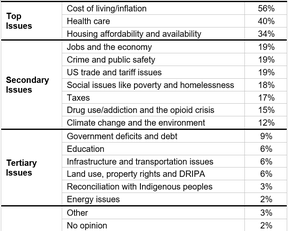
And reconciliation as a last place political priority was pretty consistent across demographics, with men, women, seniors and youth all marking it either dead last, or second to dead last.
The only cohort who felt differently were supporters of the B.C. Green Party. Among Greens, 12 per cent thought “reconciliation” was worthy of political attention.
These views aren’t all that different from the last time B.C. went to the polls.
An Ipsos poll from 2024 similarly found “reconciliation with Indigenous peoples” ranking at the very bottom of the B.C. voters policy priorities.
Nevertheless, reconciliation has dominated the interim two years of B.C. politics, with the province finding itself at the sharp end of some of the most potent reconciliation-based policy in the country.
This most notably includes DRIPA, a piece of 2019 legislation that encoded the UN Declaration on the Rights of Indigenous People into B.C. law.
Although pitched at the time as a largely symbolic gesture, last year a B.C. court declared that DRIPA effectively took precedent over all other B.C. laws.
Specifically, DRIPA encodes the principle that “Indigenous peoples have the right to the lands, territories and resources which they have traditionally owned, occupied or otherwise used or acquired.”
Although B.C. Premier David Eby originally vowed to overturn the key sections of DRIPA at the first opportunity, he later reversed course due to pressure from Indigenous advocacy groups.
“The Government of B.C. will not be introducing legislation to suspend or amend DRIPA or UN Declaration-related provisions in the Interpretation Act, in the spring legislative session,” Eby wrote in an April 20 statement co-authored with the First Nations Leadership Council.
Recent months have also seen the handing down of the landmark Cowichan v. Canada decision, which effectively transferred a large swath of privately owned land in Richmond, B.C., to the jurisdiction of the Cowichan Tribes First Nation.
The decision mentioned “reconciliation” twice in its final reasons, ruling that both Canada and British Columbia owed a “duty to the descendants of the Cowichan Nation … to negotiate in good faith reconciliation.”
All the while, B.C. has also hosted a number of name changes and statue removals similarly pitched in the spirit of Indigenous reconciliation.
Just in the last few months, Vancouver’s Patullo Bridge was renamed to stal̕əw̓asəm Bridge and a new Langley middle school was named stɑtl̓əw̓.
As of last week, visitors to Simon Fraser University are now greeted with a large sign carrying the campus’s Indigenous names of “xʷtatəl̕ləm ʔə ƛ̓ səltaɬ sme:nt” and “Xwta7ltáw̓txw tl’a Lheḵw’lhúḵw’aytn.”
“This Indigenous naming project supports SFU’s commitment to advance Truth and Reconciliation,” read an official statement.
When British Columbians are polled on the specifics of reconciliation, they still appear to support some of its main tenets in principle, but have begun to bristle at some of its political consequences.
An August poll by Research Co. found that while 59 per cent saw DRIPA as a “positive development” for Canada, an equal number (61 per cent) wanted all B.C. treaty negotiations to end until the Cowichan case was settled.
The Ipsos poll came just one week before Eby called a snap election, declaring that he needed a fresh mandate to address the “existential” threat of U.S. President Donald Trump.
In his first campaign press conference, newly minted B.C. Conservative Leader Lorne Doerkson said that his own top priority, if elected, would be to revoke DRIPA.
“I will repeal DRIPA,” he said when asked his top priority.
Observers at Eby’s Tuesday election announcement, meanwhile, noted that it was a rare instance of him beginning a public statement that wasn’t preceded by an Indigenous land acknowledgement.
Ipsos surveyed 800 B.C. adults online between Sept. 8 and 14. The precision of Ipsos online polls is measured using a credibility interval. In this case, the poll is accurate to within plus or minus four percentage points, 19 times out of 20.
The story of an Ontario grandmother reportedly euthanized against her will has been raised in Parliament this week, both in Canada and the U.K.
In July, Canadian author Kelsi Sheran published a detailed account of the death of 83-year-old Brigitte Stegemann, a German-born grandmother whose family alleges that she was given MAID at a Belleville, Ont., retirement home despite objecting to the procedure out of religious conviction.
Sheran’s account has an attending physician approving the MAID appointment after an interview with Stegemann, despite Stegemann suffering from hearing issues and being confused about basic details of her life, such as how many of her siblings are still alive.
The story was picked up this week by the U.K. Daily Mail and the New York Post, among others.
Brigitte Kranendonk, Stegemann’s granddaughter and primary caregiver, told the Daily Mail that staff explained the procedure to her grandmother as “’we’re going to give you medicine, you’re going to feel at peace. And I just want you to know that you won’t have a bowel movement.”
Conservative Leader Pierre Poilievre addressed Stegemann’s case on Tuesday, saying it “demands action” and “the Liberal government must strengthen and enforce safeguards to protect vulnerable Canadians from pressure and abuse.”
It also received a mention from David Alton, a member of the U.K. House of Lords, who cited it in the context of an assisted suicide bill just being defeated in the U.K. Parliament.
“This is the law which the pro euthanasia lobby has called for in the UK,” wrote Alton in a social media post. “Assisted Suicide would inevitably set us on the same road.”

First Reading is a Canadian politics newsletter curated by the National Post’s own Tristin Hopper. To get an early version sent directly to your inbox, sign up here.
Join the Conversation
This website uses cookies to personalize your content (including ads), and allows us to analyze our traffic. Read more about cookies here. By continuing to use our site, you agree to our Terms of Use and Privacy Policy.
KioskNews shows a cleaned-up reading view extracted from the publisher’s page — the original always lives on their site, not ours.