1976 Mindanao ‘killer quake’ memorial rises in Sultan Kudarat town
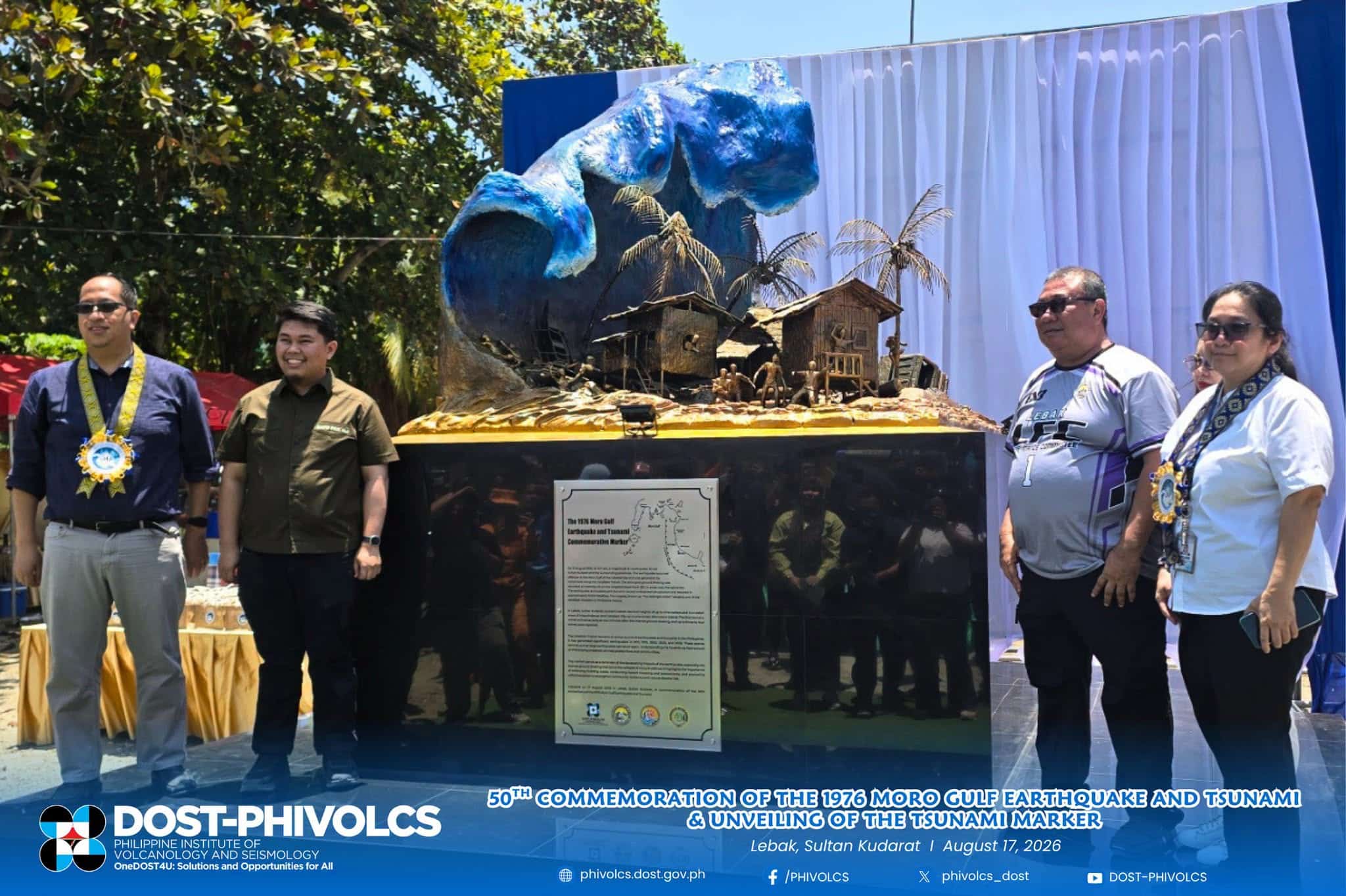

COTABATO CITY — Fifty years after the 1976 Moro Gulf “midnight killer” earthquake that triggered a tsunami which left 8,000 people dead in several parts of Mindanao, a commemorative marker was erected to serve both as a memorial to the victims and a reminder of the lingering threats of tsunamis.
The landmark was unveiled on Monday in Barangay Tibpuan, Lebak, Sultan Kudarat, the community that bore the brunt of the 1976 earthquake and tsunami, the deadliest natural disaster of its kind in the Philippines.
The magnitude 8.1 tremor, which hit at 12:11 a.m. on August 17, 1976, left at least 8,000 people dead, some 100,000 injured, and about 90,000 homeless in Cotabato City, Pagadian City, Zamboanga City, and the provinces of Sultan Kudarat, Maguindanao, Lanao del Sur, Zamboanga del Sur, Basilan, and Sulu.
Article continues after this advertisement
READ: LIST: Killer earthquakes in the Philippines
FEATURED STORIES
NEWSINFO
NEWSINFO
NEWSINFO
Sultan Kudarat Gov. Pax Ali Mangudadatu, Lebak Mayor Frederick Celestial, and Dr. Teresito Bacolcol, director of the Department of Science and Technology–Philippine Institute of Volcanology and Seismology (DOST–PHIVOLCS), led the unveiling of the first commemorative tsunami marker at the provincial capitol extension office in Barangay Tibpuan.
The unveiling forms part of the two-day earthquake- and tsunami-related activities, which started on Monday in the village, and aim to strengthen community awareness of lessons learned from the 1976 catastrophic disaster.
Bacolcol said the country must not forget the powerful 1976 earthquake that struck Sultan Kudarat and neighboring provinces around the Moro Gulf followed by a devastating tsunami.
He said the earthquake and tsunami “taught us to further recognize the natural signs of an impending local tsunami, which are ‘shake’ (earthquake), drop (water recede or rise) and roar (unusual sound).”
Article continues after this advertisement
Hardest hit by the tsunami
Lebak, Kalamansig, and Palimbang, all coastal towns in Sultan Kudarat, were among the hardest-hit areas, particularly by the tsunami, with waves reaching heights of reportedly up to nine meters or as tall as a three-story building.
Article continues after this advertisement
Bacolcol said the tsunami also caused extensive coastal damage, severely affecting fishing communities and leaving widespread damage.
The marker depicting the earthquake that struck after midnight pays tribute to the survivors, responders, scientists, government agencies, local communities, international partners, and media organizations who played vital roles in life-saving actions and efforts in the aftermath of the 1976 earthquake and tsunami.
READ: Timing helped limit Mindanao quake toll; preparedness still key – OCD
During the event, DOST-PHIVOLCS also distributed Project Earthquake, Tsunami, and Volcano Disaster Narratives for Experiential Knowledge-based Science Communication (DANAS) Sourcebook and DOST-PHIVOLCS Information Products to local officials, teachers, and local disaster risk reduction and management (LDRRM) officials.
On Tuesday, the agency held a seminar related to earthquakes and tsunamis.
Lessons learned from the disaster
The lessons learned from the disaster 50 years ago have contributed to modern disaster risk management in the Philippines, specifically improving emergency responses through science and technology, Bacolcol said.
Dolores Obales, 94, of Barangay Sta. Clara, Kalamansig, Sultan Kudarat, shared her experiences of the killer earthquake with the Inquirer.
“I was awakened by rumbling sounds, and when I tried to stand, I fell back to my bed,” she vividly recalled. “As the shaking ended, I heard people running and yelling that a tidal wave was coming and we needed to rush to the mountains, so we did without even carrying anything valuable.”
Arthur Toto Albaladjo, also from Barangay Sta. Clara, Kalamansig, recalled that the quake was so strong that it toppled coconut trees and huge mango trees.
Then 12 years old, Albaladjo said he joined the crowd rushing to the mountains because people were screaming that a tsunami was coming. He became separated from his siblings and was reunited with them only the following morning.
READ: Earthquake preparedness saves lives: What to do
Myla Fe Cañete, head of Lebak MDRRMO, said the marker immortalized the stories of that fateful night.
Your subscription could not be saved. Please try again.
Your subscription has been successful.
She said stories told by the survivors (key informants) were considered in making the diorama./coa
KioskNews shows a cleaned-up reading view extracted from the publisher’s page — the original always lives on their site, not ours.