Neither glitter, nor gold: The 17-kg rock a man tried to smash open was hiding a 4.6-billion-year-old secret
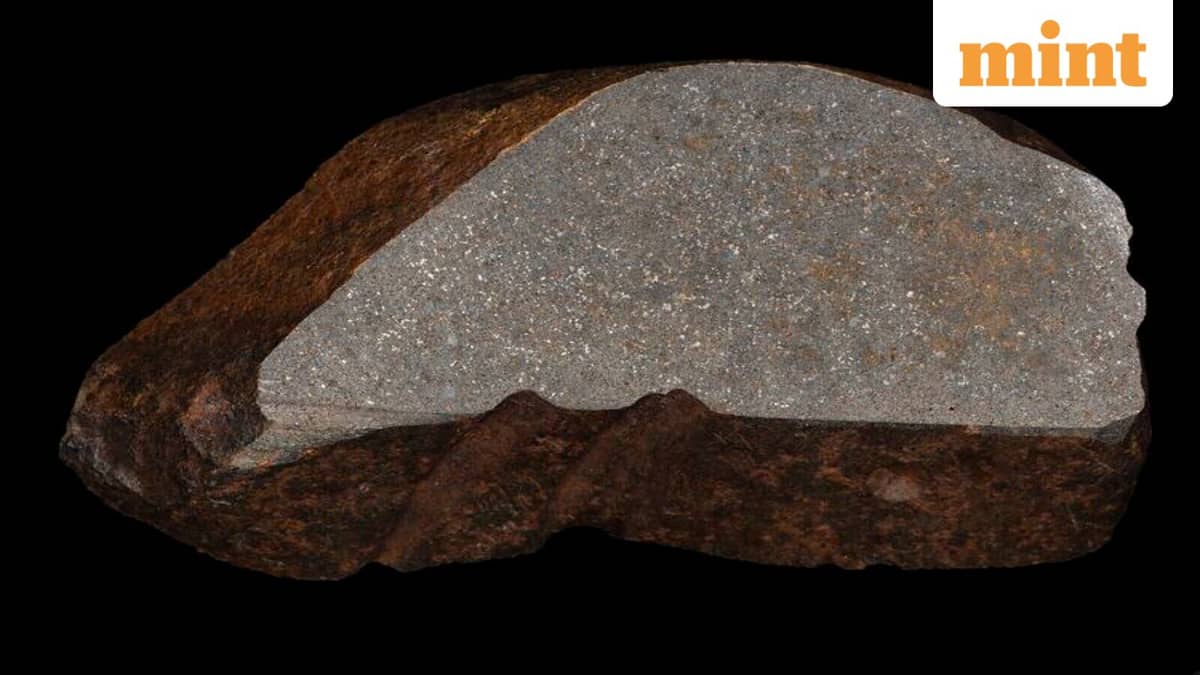
Gold was what he was looking for. But what he stumbled upon was something far older, far rarer and far more extraordinary than any nugget he could have hoped to find.
In 2015, David Hole was scouring Maryborough Regional Park in central Victoria, Australia, with a metal detector when he came across a heavy, reddish rock embedded in yellow clay. The region had a rich gold-mining history, and Hole was convinced his discovery was hiding a gold nugget inside.
He took it home, determined to uncover what lay beneath its rugged exterior. But the rock refused to give up its secret.
A rock saw failed. An angle grinder could not crack it. A drill made no difference. He even tried acid. And when all else failed, he brought out a sledgehammer.
Nothing worked.
What Hole had found was not gold. It was a visitor from outer space — a meteorite that had travelled through the cosmos for billions of years before ending up in the Australian soil.
The discovery, reported by ScienceAlert, would turn an ordinary gold-prospecting expedition into an extraordinary scientific find.
As ScienceAlert reported, the object was not a gold nugget but a rare meteorite — one that had remained unidentified for years before scientists recognised its significance.
Why the rock was so difficult to break
The unusually heavy rock caught the attention of scientists when Hole eventually took it to the Melbourne Museum for identification.
Melbourne Museum geologist Dermot Henry, who had examined thousands of rocks over his 37-year career at the museum, said very few suspected meteorites brought in by the public turned out to be genuine.
"I've looked at a lot of rocks that people think are meteorites," Henry told Channel 10 News.
Of the thousands of rocks he had examined, only two had turned out to be actual meteorites. The Maryborough specimen was one of them.
Its unusual appearance also offered clues. Henry described the rock as having a "sculpted, dimpled look", a feature created when meteorites pass through Earth's atmosphere.
"That's formed when they come through the atmosphere; they are melting on the outside, and the atmosphere sculpts them," Henry told The Sydney Morning Herald in 2019.
The rock's weight was another clue. Melbourne Museum curator emeritus Bill Birch explained that it was unusually heavy for an ordinary terrestrial rock.
"If you saw a rock on Earth like this, and you picked it up, it shouldn't be that heavy," Birch said.
What was inside the 17-kg meteorite?
Scientists eventually cut the rock using a diamond saw to examine its composition. Weighing 17 kg (37.5 pounds), the meteorite contained a high proportion of iron and was classified as an H5 ordinary chondrite.
The cut also revealed tiny crystallised droplets of silicate minerals scattered throughout the rock. These structures, known as chondrules, are among the features that help scientists study the earliest material from the Solar System.
The meteorite was named Maryborough after the town near where it was discovered. Researchers published their findings in the Proceedings of the Royal Society of Victoria.
Why is the Maryborough meteorite so valuable to science?
Meteorites are remnants of the material that existed when the Solar System was forming around 4.6 billion years ago. Unlike rocks formed through geological processes on Earth, they can preserve clues about the conditions that existed before planets took shape.
Geologist Dermot Henry said meteorites offer scientists an opportunity to study the history of the Solar System without having to travel into space.
"Meteorites provide the cheapest form of space exploration. They transport us back in time, providing clues to the age, formation, and chemistry of our Solar System (including Earth)," Henry said.
Some meteorites can reveal information about the deep interior of planets, while others contain stardust that predates the Solar System itself. Such material can help scientists understand how stars evolve and produce the elements that make up the universe.
Rare meteorites may also contain organic molecules, including amino acids — building blocks associated with life.
Where did the Maryborough meteorite come from?
Scientists believe the Maryborough meteorite may have originated in the asteroid belt between Mars and Jupiter.
The asteroid belt contains remnants of the material that formed the Solar System. Collisions between asteroids can knock fragments out of their orbits, sending them travelling through space. Some eventually cross Earth's path and fall to the planet.
"This particular meteorite most probably comes out of the asteroid belt between Mars and Jupiter, and it's been nudged out of there by some asteroids smashing into each other, then one day it smashes into Earth," Henry told Channel 10 News.
Carbon dating suggests the meteorite has been on Earth for less than 1,000 years, although its exact arrival date remains unknown. Researchers believe meteor sightings recorded between 1889 and 1951 could potentially be linked to its arrival.
Rarer than gold: Why the discovery matters
The Maryborough meteorite is among the rarest finds in Victoria, Australia. It is one of only 17 meteorites recorded in the state and the second-largest chondritic mass identified there, behind a 55-kg specimen discovered in 2003.
The rarity of such discoveries is striking, particularly in a region known for gold prospecting.
"This is only the 17th meteorite found in Victoria, whereas there's been thousands of gold nuggets found," Henry told Channel 10 News.
For Hole, the rock that resisted every attempt to break it open was ultimately a discovery far more extraordinary than a gold nugget.
"Looking at the chain of events, it's quite, you might say, astronomical it being discovered at all," Henry said.
KioskNews shows a cleaned-up reading view extracted from the publisher’s page — the original always lives on their site, not ours.