Colby Cosh: Smith won against separatism. Her battle with socialism is just beginning
Having had a few days now to watch realtime reactions to Monday’s Alberta referendum result, I keep thinking of the U.S. Civil War. It was the first major war, the first continental-scale war, to be conducted in the face of mass media, and in the presence of “news” as we now understand it; and, of course, it was itself a product of emerging new media.
Sign In or Create an Account
So a new feature of the American Civil War was realtime second-guessing of strategy and generalship; the people became capable of conducting arguments and trading information and speculating about individual leaders, even though those leaders themselves had to constantly make decisions with insufficient and incomplete information. (And historians are still arguing about it all.) No one in history before Ulysses S. Grant and William Tecumseh Sherman and Joseph E. Johnston and John Bell Hood had to face the kind of public pressure and the weight of democratic judgment they did while trying to win a war.
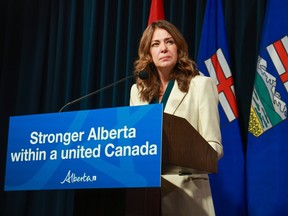
Alberta Premier Danielle Smith is a general trying to win a war — that is, the next Alberta general election, which is scheduled for almost exactly a year from now. Her problem is that she leads a “United” conservative party split nearly down the middle on whether Alberta should pursue an independence strategy, a Quebec-like political strategy. Outright secessionists and pro-American fifth columnists are a minority even in the party, but there is plenty of softer and less articulate Alberta “nationalism,” if you will.

Columnist Jesse Kline keeps you up to date with what’s happening in Israel and the effects of antisemitism on life here in Canada. Friday mornings.
By signing up you consent to receive the above newsletter from Postmedia Network Inc.
A welcome email is on its way. If you don't see it, please check your junk folder.
The next issue of Channel Israel will soon be in your inbox.
We encountered an issue signing you up. Please try again
All of this sentiment is genuinely hard to understand, classify and unify (i.e., exploit). If a Conservative leader gets the exact ideological formula right, political victory in Alberta is relatively easy for a conservative brand. The opposition New Democrats are tightly allied, and have a stronghold in the capital, but they have chosen a leader who has a long track record as the mayor of Calgary, which is where Alberta elections are decided. This record did not make Naheed Nenshi especially popular; he faces a lot of fatigue and hatred at home, where he did leave a legacy of infrastructure mistakes and disorderly finances. He has led the NDP(A) for two and a half years, and the party spent most of that time a little behind the United Conservatives in the polls. In recent ones, for whatever that’s worth, they’re level or slightly ahead.
NDP government in Alberta, though ideologically moderate by Canadian standards, left the Alberta hinterland ultra-radicalized against a repeat of the 2015-2019 socialist experiment. Exploding culture war has only made that part of the map harder for them. The referendum that was just held, with a handful of constitutional and political issues on the ballot, is a key part of the Smith strategy. Alberta sovereigntists were given the direct-democracy test they had demanded. Direct democracy, which for decades promised and then denied to Albertans by Conservative party leaders, was in itself part of the plan: this is a part of the strategic picture that might not be so obvious to observers outside Alberta.
Albertans, given a ballot to mark, rejected a Québécois strategy for intergovernmental affairs. Smith is now explicitly rallying Conservative voters against Nenshi, reminding them of the main immediate adversary. One thing that’s important to understand is that historic conservative strategy in Alberta politics involves complaining about Ottawa six days a week and never even mentioning the provincial opposition. Gen. Smith has to do something different and new. The Liberal party’s flip from Justin Trudeau to Mark Carney couldn’t have been foreseen, but Smith’s strategic scheduling turns out to have harmonized pretty nicely with the timing of federal regime change.
If I’m being honest, the separatist/sovereigntist element within Alberta’s conservative right seems for the moment to have been disarmed successfully. They don’t like the result, and they are sending out enough conspiracist trial balloons to blot out the skies, but even Mitch Sylvestre is acknowledging the need for unity against the Nenshi threat (“I won’t be the guy that splits the right”). Surging Alberta government revenues will give the premier plenty of room to bribe voters, and perhaps even to make positive policy changes. Battleground Calgary is building a fancy new hockey rink with provincial money and the folks there are vibrating with excitement. The provincial government’s war against upzoning in Edmonton, as much as I dislike it, may help fortify the UCP in the outer suburbs of the capital.
Maybe the Smith strategy will turn out to have failed in 2027, and it is probably not the plan I would have enacted in her place. But I don’t want to be the journalist who keeps confidently issuing death certificates right up until the day of Conservative victory.
National Post
Join the Conversation
This website uses cookies to personalize your content (including ads), and allows us to analyze our traffic. Read more about cookies here. By continuing to use our site, you agree to our Terms of Use and Privacy Policy.
KioskNews shows a cleaned-up reading view extracted from the publisher’s page — the original always lives on their site, not ours.