FIRST READING: As First Nations acquire new land, political control, Beijing appears to take notice
First Reading is a Canadian politics newsletter curated by the National Post’s own Tristin Hopper. To get an early version sent directly to your inbox, sign up here.
Sign In or Create an Account
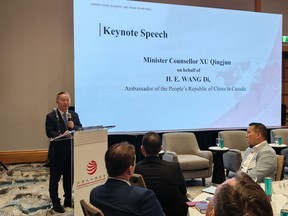
With B.C. still embroiled in controversy regarding the large-scale transfer of land and political control to First Nations, the Chinese embassy touted the completion of a summit to strengthen ties between Beijing and Indigenous groups.
Convened on Sept. 3 in Vancouver, the “economic roundtable” included Ernie Daniels, president and CEO of the First Nations Finance Authority.

Columnist Jesse Kline keeps you up to date with what’s happening in Israel and the effects of antisemitism on life here in Canada. Friday mornings.
By signing up you consent to receive the above newsletter from Postmedia Network Inc.
A welcome email is on its way. If you don't see it, please check your junk folder.
The next issue of Channel Israel will soon be in your inbox.
We encountered an issue signing you up. Please try again
In a statement, Chinese Ambassador to Canada Wang Di praised links with First Nations communities and expressed his hope that they would “lay an even more solid foundation for the China—Canada new strategic partnership.”
“The roundtable meeting discussed the future direction of China-Canada economic and trade cooperation, including cooperation on green transition, indigenous finance and community development,” read a summary by the embassy.
Also in attendance were former federal finance minister Bill Morneau and B.C. senator Yuen Pau Woo.
Summits between PRC officials and First Nations representatives have happened before. The Canada China Business Council, for one, has organized three all-Indigenous trade missions to Beijing, the most recent in 2024.
But the Sept. 3 roundtable is the Beijing-sanctioned event convened in the wake of a series of developments that have markedly increased Indigenous power, particularly in B.C.
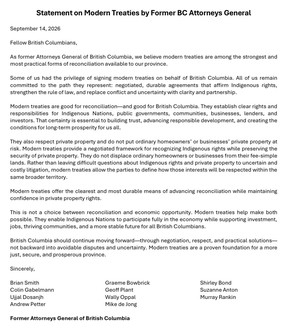
Just one year ago, in August 2025, the B.C. Supreme Court released the landmark Cowichan Tribes decision which effectively ceded 300 hectares of privately owned land in Richmond, B.C. to the control of the Cowichan Tribes First Nation.
Although the decision is being appealed, the uncertainty has since crashed real estate values in the affected area by as much as 70 per cent, according to a recent interview published by the Business Council of British Columbia.
Another landmark decision, issued by the B.C. Appeals Court in December 2025, argued that DRIPA – a piece of 2019 legislation which encoded the United Nations Declaration on the Rights of Indigenous People into B.C. – effectively superceded the province’s existing laws.
The decision specifically struck down the Mineral Tenure Act, one of the oldest laws in B.C., in part because it violated the declaration’s clause that Indigenous peoples “own, use, develop and control” any land that they’ve held traditionally.
Over the summer, an internal document published by the B.C. Ministry of Finance confirmed for the first time that more than 120,000 hectares of B.C. Crown land is in the queue for transfer to First Nations as “treaty lands.”
The lands, which include several multi-million-dollar plots of prime development land in the B.C. capital, would be exempt from local zoning and development laws.
The Vancouver “roundtable” also occurred just as Prime Minister Mark Carney is courting foreign investment for a pitchbook of Ottawa-approved “nation-building projects,” almost all of which require Indigenous participation or buy-in.
One of the most expensive items in the pitchbook is the proposed Ksi Lisims LNG terminal and pipeline, a US$28.5 billion project developed in partnership with the Nisga’a Nation.
In 2022, a report by the Canada Chinese Business Council specifically noted the economic opportunities yielded by “increased Indigenous control over lands and resources.”
“The potential for economic activity between China and Canadian Indigenous businesses and communities is immense,” it wrote.
Canadian national security officials have previously warned of Indigenous issues functioning as an easy avenue for Chinese political and economic influence.
In 2019, a report by the National Security and Intelligence Committee of Parliamentarians and obtained by independent journalist Sam Cooper warned that “indigenous officials,” in addition to federal politicians, were targets of Chinese foreign interference.
The report was critical of a 2011 summit of Indigenous leaders brought to China ostensibly to develop First Nations tourism, but with the alleged intention to “pursue Aboriginal-controlled natural resources.
“The PRC conducted research on each delegate in part to identify their ‘potential usefulness’ to the PRC,” it read.
In a 2024 Financial Times profile of First Nations efforts to increase Chinese investment, a spokesperson with CSIS, Canada’s main foreign intelligence agency, accused Beijing of attempting to appeal to Indigenous sentiments by framing themselves as fellow victims of colonialism.
“The PRC tries to undermine trust between Indigenous communities and Canada’s government by advancing a narrative that the PRC understands and empathises with the struggles of Indigenous communities stemming from colonialism and racism,” said the unnamed official.
In a Canada-U.S. trade war that has frequently descended into childish name-calling and petty snipes, the National Post’s Chris Selley has detailed new and potentially more impactful way for Canada to register its displeasure with the U.S. Although the Stanley Cup is officially under the control of the U.S.-based NHL, there is a legal argument to be made that it’s still technically property of the Crown (the cup having been created by Canadian Governor General Lord Stanley as an amateur hockey trophy). However, were Canada to demand its repatriation, NHL lawyers could just as easily argue that the contemporary Stanley Cup no longer contains any pieces of the original (which is already held in Canada at the Hockey Hall of Fame.)
First Reading is a Canadian politics newsletter curated by the National Post’s own Tristin Hopper. To get an early version sent directly to your inbox, sign up here.
Join the Conversation
This website uses cookies to personalize your content (including ads), and allows us to analyze our traffic. Read more about cookies here. By continuing to use our site, you agree to our Terms of Use and Privacy Policy.
KioskNews shows a cleaned-up reading view extracted from the publisher’s page — the original always lives on their site, not ours.