Adam Zivo: Canada-Ukraine drone deal, exactly what our military needs
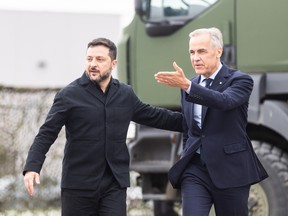
Canada and Ukraine deepened their relationship on Thursday by signing a series of strategic partnerships primarily focused on defence. This is a good development, as the deal is structured in a way that will strengthen Ottawa’s military prowess, but more details are sorely needed to properly assess the full return-on-investment.
Sign In or Create an Account
The enhanced alliance was announced in Calgary by Prime Minister Mark Carney and Ukrainian President Volodymyr Zelenskyy, who is visiting Canada for three days. Their proposition was straightforward and commonsensical: both countries benefit by combining Canadian financing and manufacturing with Ukrainian technology and battlefield expertise.
Per the new deal, Ottawa and Kyiv will collaborate on the production of drones, counter-drone technologies and “uncrewed systems” (unmanned war robots). Such a partnership has the potential to rapidly modernize Canada’s arsenals, as four years of war have transformed Ukraine into a global leader in these domains, rivalled only by Russia.

The National Post newsletter that doesn’t hold back, giving readers the unvarnished truth on media, politics and culture.
By signing up, you consent to receive the above newsletter from Postmedia Network Inc.
A welcome email is on its way. If you don't see it, please check your junk folder.
The next issue of Right? will soon be in your inbox.
We encountered an issue signing you up. Please try again
Ukrainian drones and robots are now far more sophisticated and cost-efficient than their NATO-designed counterparts, and, furthermore, Ukrainian soldiers are uniquely experienced at deploying these assets. The advantage this confers cannot be overstated: recent war exercises have repeatedly ended with Ukrainian forces utterly dominating their NATO peers.
Western allies have been clamouring for Kyiv’s technological and strategic innovations, hoping that, through mimicry, they can turbocharge their own militaries. Over the summer, for example, the Ukrainians began exporting their drones to the United States and gave the United Kingdom access to data gathered from tens of thousands of drone flights, which will be used to train AI-enhanced systems that can resist electronic jamming.
If Carney’s deal secures similar — or more substantial — technology transfers, then it will be of immense value to Canada. Cheap and effective Ukrainian drones could revitalize a decrepit military burdened by broken and outdated equipment. They could be particularly useful for patrolling and defending our vast Arctic territories, whose sovereignty is increasingly under threat.
Yet, the news releases associated with Thursday’s deal are frustratingly vague and, if read carefully, suggest that Ukrainian technology may not be leveraged as intensely as some might assume.
In the short term, Ottawa will award $50 million in initial contracts to six Canadian suppliers, who will manufacture drones using domestic, British and Australian technology. The stated goal of this “first step” is to rapidly grow Canada’s drone arsenal — currently a paltry 2,000 units — by a factor of ten. While this endeavour is commendable and arguably overdue, it ultimately does not leverage Ukrainian innovation.
As far as Ukrainian collaboration goes, Carney’s announcements are unspecific and contain only one concrete commitment: a partnership between General Dynamics Mission Systems-Canada and “Green Tech Harvest,” a Kyiv-based drone company.
The details and budget of this partnership have not been publicly disclosed, unfortunately. How much money is Ottawa investing here? What will bilateral collaboration look like? How exactly will Canadian experts learn from their Ukrainian colleagues? It’s anyone’s guess.
Green Tech Harvest itself is also rather mysterious. Its website omits any mention of defence manufacturing and exclusively focuses on “agri-tech innovations” and “eco-friendly farm management solutions.” Yet, by searching the corporation by name and identification number, one can verify that it has, over the past year, produced drones for Ukraine, the United States and the European Union (plus Canada now, of course).
Such a client list confirms that this is a serious company that is, in all likelihood, obfuscating its public profile to maximize operational security. Yet, in any case, this opaqueness, even if understandable, leaves Canadians further befuddled. How is the public supposed to assess the value of its much-promoted drone deal if so little is known about a key Ukrainian partner?
Defence contracts obviously require a certain degree of secrecy, but within a limit. Some more details would be helpful for an initiative that has been so well-publicized and which remains inescapably political.
That being said, even if, in the worst case scenario, Canada’s direct collaboration with Ukrainian drone experts ends up being relatively limited, the deal still provides opportunities for our domestic industry to grow.
Carney has committed to giving Ukraine one third of Canada’s new drones, which means that Canadian suppliers will have countless chances to test, and iteratively improve, their wares in real-world conditions. Such practical experience is invaluable and is precisely why Kyiv has managed to become a global leader in modern warfare.
From this perspective, it might be helpful to think of the funds spent on these drones as being analogous to a research-and-development project, one that will allow Canada to proactively innovate alongside Ukrainians, rather than just following their lead.
This cost may seem high to some, but it represents only a sliver of our overall defence budget. Ottawa has, on average, provided around $1.8 billion in military aid to Ukraine each year — which is roughly three per cent of Canada’s 2026 defence budget of $62.7 billion.
Using this as an anchor figure, it seems that sending Ukraine a large number of drones would not be particularly expensive (at least in the context of national defence, which is never cheap), and would pay enormous dividends by slingslotting Canada into battle-tested modernity.
National Post
Join the Conversation
This website uses cookies to personalize your content (including ads), and allows us to analyze our traffic. Read more about cookies here. By continuing to use our site, you agree to our Terms of Use and Privacy Policy.
KioskNews shows a cleaned-up reading view extracted from the publisher’s page — the original always lives on their site, not ours.