Ottawa raking in billions more than expected thanks to inflation and natural resource revenue
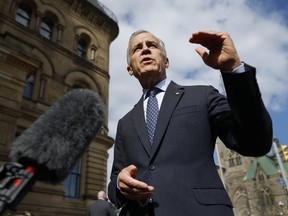
The federal government may be on track to take in almost $20-billion more in taxes and other revenue this year than had been expected less than six months ago, National Post has learned, potentially handing Prime Minister Mark Carney much more room in his second budget to cut taxes, trim Canada’s massive deficit or spend.
Sign In or Create an Account
In its Spring Economic Update in late April, the government said it expected to rake in $529.6-billion this fiscal year, which would have been an increase of 3.5 per cent over the previous year.
But instead, according to government figures up to the most recent month, Ottawa has so far this year taken in 7.4 per cent more than the previous year, more than double the pace of growth that had been expected. If the growth continues throughout the year, that translates to $549.4-billion, or $19.8-billion more than what had been expected in April.
Economists say the federal government, like the provinces and territories, is sitting on extra cash this year due to higher-than expected income tax payments, a small jump in inflation, and strong markets for many natural resources, particularly oil. That means increases in both corporate income tax and sales tax.
Trevor Tombe, professor of economics at the University of Calgary and director of fiscal and economic policy at the School of Public Policy, said he’s surprised at the federal government’s revenue spike, although he emphasized that Ottawa shouldn’t assume that those increases will continue.
Canada’s trade relationship with the U.S. remains uncertain while growth has been sluggish and the government’s fiscal situation is dire, leading to questions about how long the revenue spike will continue, economists say.
“It’s hard to count on anything,” said Tombe.
Some had expected an increase in federal revenue, just not this big.
In an update issued earlier this month, the Parliamentary Budget Office (PBO) also forecast a healthy increase in federal revenue, a jump of 5.4 per cent or $538.7-billion this fiscal year over the previous year, or $9.1-billion higher than what had been forecast in the spring update.
With the Carney government scheduled to unveil its budget on Nov. 5, Finance Minister François-Philippe Champagne and Finance Canada officials are poring over options what to do with the extra money.
John Fragos, a spokesman for Champagne, declined to comment on what Ottawa’s revenue numbers will look like in the budget.
But economists warned that it would be a mistake for the government to view the extra revenue as a windfall or a long-term trend. Tombe said the government should be thinking long term, particularly about future growth and how to pay for such things as support programs for seniors and the defence spending plans that have already been announced.
“That’s where the government should be focused,” said Tombe.
Don Drummond, former senior executive at the Department of Finance and now a fellow-in-residence with C.D. Howe Institute, warned that it would be a big mistake for the Carney government to assume that any revenue increase will continue.
Oil prices may not remain this high, population growth has waned and productivity remains low, said Drummond, and the government has already allocated big bucks for new spending promises and tax cuts.
Ottawa should take a prudent approach and assume modest economic growth in the coming years, Drummond said.
“The bottom line is there is no windfall available for new initiatives in the (upcoming) budget,” Drummond wrote in a memo for the C.D. Howe Institute that is expected to be released later this week. “And even if there was, it should be applied to lowering the deficit and debt.”
Although reducing the deficit hasn’t so far been a government priority, the Carney government seems to have taken a more long-term approach to the economy than the previous regime under Justin Trudeau. Carney has focused much of his effort since taking office on trying to solidify the pillars of the Canadian economy: infrastructure for exports and transportation of goods, improving the investment climate and supporting trade relationships.
The government announced a so-called mega-deduction last month, for example, at an international investment summit in Toronto that it hopes will spur investment, particularly in capital-intensive industries such as energy, mining, transportation, and technology.
The changes, which have not yet become law but may well be included in the budget, are expected to cut Canada’s projected tax rate on new investment, a key metric for large investors, by slightly more than half, to about 6.4 per cent from 13 per cent. The price tag for the changes is an estimated $36.5-billion over the next five years.
For those concerned about Canada’s fiscal problems, Champagne has not provided much relief in recent months. He has described Canada’s fiscal position as the best in the G7 and has said the government will continue to make what he calls economic “investments,” instead of reducing the deficit.
“I think Canadians can understand that we have a strong fiscal position and we’re investing in the things that will generate growth to the country,” he said in July.
But Ottawa is staring at an increasingly large pile of red ink. In the government’s spring update, Champagne said the 2025–26 deficit was projected to be about $66.9 billion, down from the $78.3 billion that had been projected in last fall’s budget. That drop was due largely to a fiscal windfall from higher oil prices.
The federal government has now accumulated more than $1.3 trillion in total debt, almost half of which has been added over the last five years.
National Post
Our website is the place for the latest breaking news, exclusive scoops, longreads and provocative commentary. Please bookmark nationalpost.com and sign up for our daily newsletter, Posted, here.
Join the Conversation
This website uses cookies to personalize your content (including ads), and allows us to analyze our traffic. Read more about cookies here. By continuing to use our site, you agree to our Terms of Use and Privacy Policy.
KioskNews shows a cleaned-up reading view extracted from the publisher’s page — the original always lives on their site, not ours.