Rob Breakenridge: The economics of Alberta separation would be disastrous for everyone
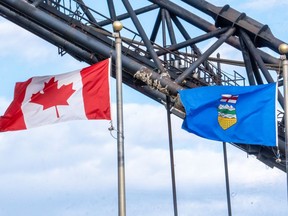
There’s a level of irony in the deep admiration so many Alberta separatists harbour for our neighbour to the south.
Sign In or Create an Account
After all, there is no legal process for an American state to separate from the U.S. and, thus, such a movement could not exist there. Of course, the United States underwent a far messier and bloodier process before concluding that divorce shall forever be off the table.
In our 159 years as a nation, we’ve never had any kind of a breakup. And while there is indeed a legal pathway that exists for a Canadian province to leave, there is no precedent.

Columnist Jesse Kline keeps you up to date with what’s happening in Israel and the effects of antisemitism on life here in Canada. Friday mornings.
By signing up you consent to receive the above newsletter from Postmedia Network Inc.
A welcome email is on its way. If you don't see it, please check your junk folder.
The next issue of Channel Israel will soon be in your inbox.
We encountered an issue signing you up. Please try again
That doesn’t and shouldn’t leave us flying blind into a potential catastrophe. It’s reasonable to assume that a dismantling of Confederation would be costly, convoluted, and potentially ugly.
The rosy and optimistic forecasts from separatists that executing their plan would be clean, easy, and cheap have always seemed like wishful thinking detached from reality.
And now, thanks to work commissioned by the Alberta government and undertaken by the University of Calgary’s School of Public Policy, we can see just how unrealistic those assumptions are.
But this is not just a warning for Alberta, and it’s not just Alberta that could suffer from a breakup. This should be a wake-up call for the rest of Canada, too.
Despite some alarming and stark conclusions, it’s actually a rather thorough and balanced report. On top of that, the report was overseen and analyzed by an expert advisory panel, chaired by noted economist Jack Mintz.
As both the report and the panel assessment conclude: separation would entail very real and very significant short-term costs, even under a best-case scenario. There is also a considerable degree of uncertainty when looking at the longer term.
But both conclusions are also in agreement on this point: the fallout would extend well beyond Alberta’s borders, as such a rupture would cause tremendous harm to Canada’s economy, too.
The School of Public Policy report is focused on two scenarios: one — the “smooth” option — would entail a quicker and more favourable accommodation of Alberta’s secession. The other — the “difficult” option — entails a more drawn-out, complicated process.
Between those two scenarios, the cost of leaving one country and establishing another ranges from $50 billion to $170 billion, just in the first five years, and that’s just the fiscal impact. The economic impact of that upheaval would come on top of that.
There’s an obvious up front cost for any subnational government promoting itself to an independent state, and taking over those federal responsibilities and institutions.
So even under a best-case scenario, which the report doesn’t shy away from presenting, there is a substantial cost in the short term. While there could be a potential longer-term upside, it remains highly uncertain. As these reports note, many of those “major factors” that will shape the ultimate outcome “are not fully controllable by Alberta.”
At the other end, the “difficult” scenario is rather bleak. The report forecasts that in those first five years, there could be a GDP contraction of 10 per cent, a comparable percentage of employment loss, a $5000 drop in wages, and a massive debt of well over $400-billion. Looking longer term, it’s even uglier, as Alberta’s economy, wages, and workforce shrink even further.
Importantly, though, the rest of Canada does not emerge unscathed from Alberta’s departure
As the panel report notes, such a national disruption would come at the time when trade and geopolitical uncertainty are already weighing heavily on Canada’s economy.
Among the potential consequences for Canada resulting from Alberta’s departure: a decline in the Canadian dollar, a roughly $18-billion dollar hole in the federal budget, higher inter-provincial trade costs, a 15 per cent reduction in GDP, and a five per cent drop in per-capita GDP.
Politically, there would be one province (B.C.) cut off from the rest of the country, and another province (Quebec) where separation could become far more likely.
Then there’s the American factor. As the report points out, separation would “make Alberta more dependent on shipping oil through the U.S.” The Americans could be co-operative, or they “might try to take advantage of Alberta’s lack of other options.”
Based on current trends, the latter seems far more likely.
In short, we’re facing a true lose-lose scenario. Now’s an ideal time to come to grips with that.
It’s not just for Albertans to face the risks and uncertainty of breaking away; it’s also the rest of Canada that needs to understand the benefit of keeping Alberta within Confederation. As the panel report notes, this will hopefully result in “more effective and accommodating responses” to Alberta’s concerns and aspirations.
Whether it’s Alberta or any other province, separation is unavoidably “a complicated, lengthy and contentious exercise.” It’s also clearly a risky gamble.
That doesn’t mean forever closing the door on any potential future provincial exit, nor should it mean complacency in the idea that we’re simply and always better off together.
We have something worth preserving, but that’s not always as apparent as it should be. Here’s our wake-up call to fix that.
Rob Breakenridge is a Calgary-based podcaster and writer. He can be found at robbreakenridge.ca and reached at rob.breakenridge@gmail.com.
Join the Conversation
This website uses cookies to personalize your content (including ads), and allows us to analyze our traffic. Read more about cookies here. By continuing to use our site, you agree to our Terms of Use and Privacy Policy.
KioskNews shows a cleaned-up reading view extracted from the publisher’s page — the original always lives on their site, not ours.