World Bank: 4Ps a ‘far more effective’ program for reducing poverty
Already have Rappler+?
to listen to groundbreaking journalism.

4PS. Beneficiaries of the Pantawid Pamilyang Pilipino Program learn about digital financial platforms in a Department of Social Welfare and Development event in Brooke's Point, Palawan, May 31, 2024.
4Ps Facebook page
Rather than being merely the ayuda program critics sometimes portray it as, the Pantawid Pamilyang Pilipino Program may actually have the 'strongest demonstrated poverty-reduction impact among major transfer programs,' according to the World Bank
AT A GLANCE
- The World Bank praises the Pantawid Pamilyang Pilipino Program (4Ps) for its effectiveness in reducing poverty, estimating it delivers significantly more poverty reduction per peso spent compared to other government assistance programs.
- The 4Ps targets poor households specifically, with an additional 1% of GDP invested in the program associated with a 4.4-percentage point reduction in the poverty headcount, potentially lifting 2 million Filipinos above the poverty line.
- Despite its success, the program faces budget cuts and criticism regarding its long-term effectiveness, as many beneficiaries remain below the poverty threshold even after years of assistance.
This is AI-generated. Read the article for full context. Report any errors.
MANILA, Philippines – For families enrolled in the Pantawid Pamilyang Pilipino Program (4Ps), the cash assistance given by the government is meant to help keep children in school and support their health, giving households living in poverty a little more room to get by. And if you ask the World Bank (WB), the program has been a success.
The WB’s latest assessment suggests that the money spent in this targeted program is doing more to reduce poverty than many other forms of government assistance.
“The message is clear: 4Ps is far more effective a program,” World Bank senior economist Jaffar Al Rikabi said during the launch of the lender’s Philippines Public Finance Review on Monday, September 28.
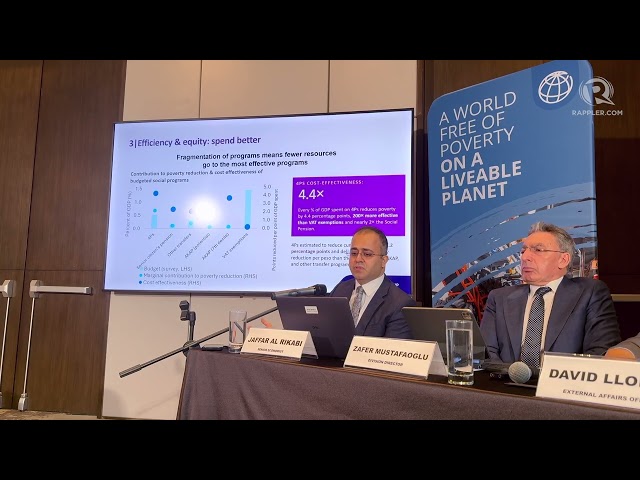
The WB estimates that the 4Ps delivers around 200 times more poverty reduction per peso spent than VAT exemptions, and about twice as much as the social pension for indigent senior citizens. The program itself reduces the country’s poverty rate by around 2.2-percentage points (ppts), which Al Rikabi described as “much more than any other program.”
The Philippines’ broad VAT exemptions are meant, in part, to lessen the cost of goods and services for lower-income households. While the World Bank has not identified which specific exemptions it finds ineffective, it has called for a review of non-food VAT exemptions. Examples of such exemptions include medical and hospital services, books and educational materials, some prescription medicines, and lower-priced residential housing, which are covered under Section 109 of the Tax Code as amended by the TRAIN and CREATE laws.
The problem, the WB said, is that richer households end up capturing more of the benefits from VAT exemptions simply because they spend more. “Richer households consume more exempted goods in absolute terms,” World Bank senior economist Jaffar Al Rikabi said, noting that their higher purchasing power means they buy more goods overall. Higher-income households are also more likely to buy their goods and services from large formal stores where the VAT applies.
“What we’re trying to show here is that a policy that is intended to support the poor actually does it, but in a quite poorly targeted manner,” Al Rikabi said.
By contrast, the 4Ps specifically targets poor households. In its report, the World Bank describes it as having the “strongest demonstrated poverty-reduction impact among major transfer programs,” adding that an additional 1% of GDP invested in 4Ps is associated with a 4.4-percentage point reduction in the poverty headcount.
That explains why the WB is calling for more of the government’s already existing social protection budget to be redirected toward 4Ps, rather than cutting the program’s spending. Shifting funds from less targeted transfers toward 4Ps or a similarly “registry based successor” could reduce the poverty headcount by an estimated 2 ppts. (READ: Poverty rate hits record low 9.7%, but millions are one crisis from sliding back)
“This would lift approximately 2 million Filipinos above the poverty line within the existing social protection budget,” the WB said in its report.
Criticism against 4Ps
The World Bank’s high praise for the program, however, comes just as funding for it under the budget is set to decline. The 2026 budget provides around P112.9 billion for 4Ps, while the proposed 2027 allocation falls to P99.1 billion, intended for 3.5 million households.
The 4Ps has also long faced questions about whether the cash assistance program truly helped families move out of poverty.
In 2022, the Commission on Audit (COA) said the program’s poverty reduction performance needed a closer look. The COA flagged that around 90% of the more than 4 million active beneficiary households stayed below the poverty threshold despite being in the 4Ps program for seven to 13 years and receiving a combined P537 billion in cash grants as of June 2021.
Senator Erwin Tulfo also proposed in 2025 replacing monthly 4Ps assistance with livelihood capital that beneficiaries could use to start small businesses, arguing that the existing setup was similar to “giving alms” to the poor.
That stigma has also played out online. A Rappler analysis with data forensics group The Nerve in May found 4Ps beneficiaries being blamed in viral Facebook posts for higher Meralco electricity bills after the expanded Lifeline Rate Subsidy took effect. The subsidy charge was only P0.01 per kilowatt-hour, while the much larger increase in bills came from generation charges. – Rappler.com
KioskNews shows a cleaned-up reading view extracted from the publisher’s page — the original always lives on their site, not ours.