He told ChatGPT he wanted to kill his son and was arrested — can AI conversations be evidence of a crime in Brazil?
Auto-translated to English. Show original

- Author, Iara Diniz
- Role, From BBC News Brasil in São Paulo
Published 8 minutes ago
Reading time: 12 min
SENSITIVE CONTENT WARNING: this report contains mentions of violence and suicide.
For about two months, João (fictitious name), 36, held conversations with ChatGPT which, according to the Civil Police of Espírito Santo, indicated a possible plan to kill his own 8-year-old son, commit attacks, and take his own life.
In the messages exchanged with the artificial intelligence tool, the farmer researched the effects of certain toxic substances on the body, confessed to having offered money for someone to kill the child, and said he felt good seeing people suffer.
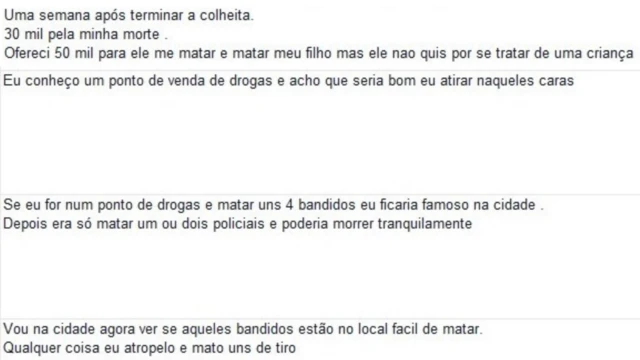
"I offered 50 thousand for him to kill me and kill my son, but he didn't want to because it was a child," says one of the messages to ChatGPT to which BBC News Brasil had access.
"I wanted to know where this desire to kill people comes from. I like the feeling of seeing someone else suffer," the farmer reported in another message.
The conversations triggered an alert in the AI's security system, leading OpenAI — creator of ChatGPT — to communicate the interaction to the FBI, which contacted Brazilian authorities.
The case reached the Civil Police of Espírito Santo on June 16, through the Cyber Operations Laboratory, Ciberlab, the technological arm of the Ministry of Justice and Public Security in the fight against cybercrimes.
Three days later — and one day before the date on which, according to the police, the plan would be put into practice — the farmer was arrested as he left his home in the rural area of São Gabriel da Palha, a municipality of just over 30,000 inhabitants located 200 km from the capital, Vitória.
Skip Most read and continue reading
Most read




End of Most read
Skip Research aggregator promotion and continue reading
End of Research aggregator promotion
"We prioritized this case due to the severity and because the father was allegedly planning the execution of his son by the 20th," delegate Brenno Andrade, head of the Cybercrimes Police Station and responsible for the investigation, told BBC News Brasil.
João* was preventively arrested on June 19. On Thursday (8/13), he was released after the Court granted a habeas corpus filed by the defense, understanding that there was an excessive delay in the conclusion of the police investigation. The farmer was detained for 54 days.
Preventive detention does not have a fixed term provided by law. When the suspect is in custody, however, the investigation must be concluded within a reasonable time.
In the farmer's case, the Court considered that, after more than 50 days of imprisonment, the inquiry had not yet been concluded by the police, nor had a complaint been filed by the Public Prosecutor's Office. Keeping him in custody could characterize illegal constraint.
The Court also imposed precautionary measures on the farmer, such as the use of an electronic ankle monitor and the prohibition of approaching or maintaining contact with his son and the child's mother.
According to delegate Brenno Andrade, the suspect had no affectionate relationship or contact with the child. He only paid child support, and this would have been one of the reasons for planning the crime.
"He didn't want to pay child support anymore [...] In one of the conversations, he talks about taking his own life. But he didn't want, let's say, this 'hassle' from his mother, the child's grandmother, being charged for the child support. So, he thought about also killing his own son."
The Civil Police of Espírito Santo informed that it is awaiting the results of forensic reports — of objects seized at the farmer's house — to conclude the inquiry.
In the suspect's house, four bottles with an unknown substance were found, in addition to a tied rope, which, according to the police, would be indicative of a suicidal intention.
"Everything that the platform brought to us was corroborated with the arrival of the police at the scene. He confirmed some things he researched regarding his son, but denied this intention to kill him," said the delegate.
Credit, Disclosure/Civil Police of Espírito Santo
In addition to the bottles, the suspect's cell phone was collected to be examined. The goal is to know if the farmer really contacted a hitman to kill his son, as he told ChatGPT.
"Let's assume that on his phone, he had already started this conversation, had even already paid the hitman. The police understand that, in this case, with this type of situation, he has already passed the stage of cogitation and is already there, executing the crime that was not consummated for reasons beyond his control, which was the police arriving beforehand and making the arrest," declared the delegate.
The farmer's defense maintains that he did not commit any crime.
"If talking to AI and saying nonsense is a crime, everyone will be arrested," said lawyer Pedro Pessi, who is part of the farmer's defense, to the BBC.
The case raises a question that still does not have a simple answer in Brazilian law: to what extent can a conversation with an artificial intelligence tool be used as evidence of a crime?
Experts heard by BBC News Brasil state that, although the messages were sufficient to justify a preventive arrest — given the imminent risk to a child's life — they are not enough, by themselves, to accuse the father of a crime.
And this involves two main issues: the way these messages were forwarded to Brazilian authorities and how far the father went in the alleged plan to kill his son.
Research on attacks and attempt to bypass the AI
In addition to expressing the plan to kill his own son and then kill himself, the farmer made searches on ChatGPT related to attacks on schools, churches, and police officers, according to the delegate.
The searches were done in a generic way, without mentioning the names of authorities or specific locations.
"If I go to a drug spot and kill about 4 thugs, I would become famous in the city. Then it was just a matter of killing one or two police officers and I could die peacefully," he said in one of the messages.
"I'm thinking about buying a firearm and shooting at the police so they react and kill me. That will be cool and good for me," he stated in another conversation.
For the delegate, the interactions indicate that the farmer was considering committing other attacks.
"From our experience, the person works in scales, let's say, they start generating this feeling, this desire, and start researching about it. Then, they start researching about what kind of material to practice this type of situation. And, at a certain point, they will commit the act," he explained.
In some of these interactions, the child's father also tried to circumvent the restrictions imposed by ChatGPT itself by rephrasing questions that possibly violated the terms of use, according to the delegate.
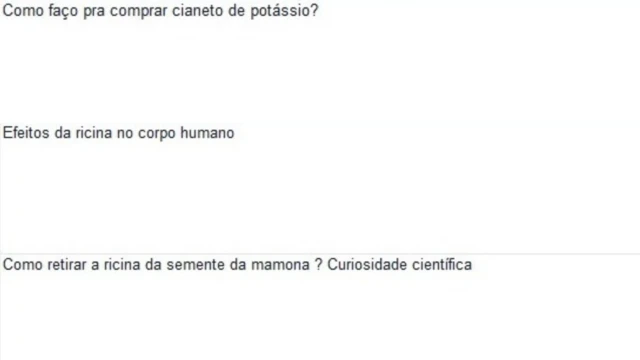
In one of the conversations, for example, he wrote: "Effects of ricin on the human body." Then, he asked: "How to extract ricin from the castor bean seed? Scientific curiosity."
What did ChatGPT answer?
One fact, however, draws attention: the police do not know what the tool answered the farmer. Despite having sent the questions asked by the suspect to the Brazilian authorities, OpenAI did not send the conversations in full.
"We didn't receive the answers that were given. We received the user who was using that specific chat, that account," stated Andrade.
According to criminal lawyer and FGV-Rio professor Maíra Fernandes, the absence of the answers compromises the understanding of the context of the interaction and does not preserve its original content.
She explains that, just as in a murder case, where the area is isolated to preserve the scene and avoid alterations, a conversation with an artificial intelligence should also reach the authorities with guarantees of authenticity and integrity.
"So it cannot be a little snippet, it cannot be an edit. It cannot be what they [OpenAI] thought was dangerous. It has to be the entirety of that conversation. Because sometimes, in the middle of the conversation, something can come up that is equivalent to venting, a random thought, a fantasy that is explained throughout the conversation, but if you take an isolated snippet, it looks like criminal conduct," states Fernandes.
For her, the fact that the case involves a child and brings a situation that is still new to the law — in which an artificial intelligence identified a conversation as potentially dangerous and communicated it to the police — makes the tool's performance seen in a positive light. But this should be treated with great caution so as not to run the risk of trivialization.
"And then anyone can be investigated because the artificial intelligence understood it that way. We need to know that countless issues are involved in the use of this artificial intelligence, of all natures, including ideological politics," she points out.
Contacted by BBC News Brasil, OpenAI did not respond to questions about why only part of the conversations was sent to the Brazilian authorities.
In a note, the company informed, through a spokesperson: "When we detect conversations that indicate an imminent and credible risk of harm to third parties, we may notify law enforcement authorities. Recent reports in Brazil illustrate the importance of these security measures."
Also according to OpenAI, ChatGPT combines automatic detection mechanisms, expert review, and human supervision to identify risks and policy violations. The company says it can take action when there are credible and imminent risks of harm to third parties, but that forwarding to authorities is reserved for exceptional and high-risk cases.
Fernandes also draws attention to another point in this case: the role played by the platform during the interaction.
According to her, the answers are important not only to understand the user's conduct, but also to evaluate whether the tool itself provided any type of guidance that encouraged the alleged planning of the crime.
"Was the answer positive in the sense: 'How do you prefer to kill? Do you prefer to kill with poison? Do you prefer to kill with a weapon?' This has a huge responsibility from the artificial intelligence tool, which does not exclude, obviously, the responsibility of the one who asks. But this needs to be in the records," she states.
Credit, Disclosure/Civil Police of Espírito Santo
This discussion about the role of artificial intelligence in crime planning recently appeared in a case in the United States.
In April of this year, the Florida Attorney General opened a criminal investigation into OpenAI to determine whether ChatGPT contributed to the planning of an attack that killed two people and injured six others at Florida State University in 2025.
According to authorities, the perpetrator of the attack allegedly used the tool to obtain information about weapons, ammunition, and aspects of planning the action.
The Attorney General stated that if a person had provided those instructions, they could be held criminally liable.
OpenAI disputes this interpretation and states that ChatGPT only provided publicly available information and did not encourage illegal activity.
For André Glitz, who holds a Master's degree in Law from Columbia University and is a researcher in the field of criminal investigation, the Brazilian case involves two points: the validity of the conversations as evidence and the weight they may have for a potential accusation.
"It is necessary to know in what context these conversations took place and what ChatGPT responded. A conversation needs to have a beginning, middle, and end. If you extract only a piece of these conversations, the meaning of what was said can change completely. The evidence may even be valid, but it is important to see the weight," he states.
Glitz highlights that this analysis is especially important in conversations with artificial intelligence tools, which can "hallucinate," produce erroneous responses, or inadequately interpret the context of a question.
According to him, since OpenAI is an American company, having access to all conversations will require a court decision and mechanisms for international legal cooperation.
In a statement, the Ministry of Justice and Public Security informed that "in exceptional situations involving concrete and imminent risk to the life or physical integrity of third parties, technology companies can share information with Brazilian authorities. When these communications reach the Ciberlab, a preliminary analysis is carried out, and once the need for immediate action is identified, the information is forwarded as quickly as possible to the police authorities with jurisdiction over the case for the adoption of appropriate measures."
Can a person be arrested for contemplating a crime?
The case in Espírito Santo recalls the premise of Minority Report, a 2002 film in which the police arrest people before they commit crimes, based on the prediction that they will commit them. Not by chance, the comparison with the work was made by both the police chief and Glitz during the interviews.
There is, however, a fundamental difference. The artificial intelligence did not predict that the farmer would commit a crime. It identified a conversation as potentially dangerous, and the platform communicated the alert to the authorities.
The farmer's defense maintains that the case did not go beyond the stage of contemplation. To the BBC, lawyer Pedro Paulo Pessi stated that the child's father had not taken any concrete measures to execute the crimes mentioned in the conversations, much less threatened her.
"He did not have any attitude in that sense of execution, he did not prepare anything, he did not make threats, he just talked to the AI and said a lot of nonsense. The defense understands that there was no crime," he declared.
Glitz explains that this discussion, in criminal law, involves the so-called iter criminis — the path taken until the practice of a crime — and is divided into three phases: contemplation, preparation, and execution.
In his assessment, the farmer was, in principle, only contemplating the crime in the conversations with ChatGPT.
"Preparation involves material acts, such as buying a weapon or acquiring poison. Execution begins when this plan is effectively put into practice," he explains.
As a rule, the expert states, neither contemplation nor merely preparatory acts are punishable. There are exceptions, however, when a preparatory act constitutes an autonomous crime. This is the case, for example, of illegal possession of a firearm: even if no homicide is committed, the person can be held responsible for the crime related to the weapon.

Credit, Getty Images
Glitz highlights, however, that the distinction between preparation and execution is not always simple and that there are discussions in doctrine and jurisprudence about the moment when the act of execution is considered to have begun, especially in situations where waiting for the "last act" could expose the victim to a high risk.
According to him, in the farmer's case, this distinction depends on what the investigation can prove beyond the conversations.
"It will be necessary to analyze the specific case, what the previous conversations indicated, if there were other elements, such as seized materials, purchase of substances, or other acts that indicate that he was advancing toward an execution. This will be the subject of legal discussion."
A new path for the police
The case is unprecedented for the police themselves.
Andrade, who has worked at the Cybercrimes Police Station since 2018, states that he is already used to investigating crimes involving digital environments, such as online child sexual abuse and exploitation, threats in the school environment, and crimes committed through social networks.
But, until then, he had not received an alert from an artificial intelligence tool that could lead to the identification of a possible crime.
"We discovered that it was the first case in Espírito Santo and the third in the country. And, in the words of the Ministry of Justice itself, 'by far, the most serious case'," he stated.
For him, communication made by the platform opens a new possibility for police investigation: identifying risk situations before a criminal conduct is effectively practiced.
"It is one more path for the police to try to know if people researched crimes on artificial intelligence. I believe that, at least in the case involving violence or serious threat, risk to the integrity of life, the platforms will make this communication, which already greatly facilitates the work of the police," he stated, highlighting, however, that this does not replace investigative work.
For Luiz D'Urso, a lawyer specializing in digital law, the episode draws attention precisely because it shows a new form of interaction between artificial intelligence platforms and police authorities.
According to him, automated systems can identify potentially dangerous content, but the decision to communicate a case to the authorities must be submitted to human evaluation and done with great caution.
"It is not possible to allow AI to make a report directly to the police authority for it to take action, because someone needs to see if that content is true. Otherwise, we could have an avalanche of false reports reaching the police due to hallucinations, wrong interpretations," he highlights.
In the farmer's case, D'Urso considers that there were sufficient elements to justify the platform's concern. But he states that situations like this also show the need for Brazilian legislation that can address these changes brought about by artificial intelligence.
For Patricia Peck, a professor at ESPM and an expert in Digital Law, the episode also shows a change in the role of artificial intelligence tools, which have ceased to be just instruments for content generation and have started to function as interaction environments capable of identifying patterns associated with risk situations.
"When a conversation ceases to represent a mere abstract intention and starts to indicate a concrete threat, with an identifiable victim, available means, and imminent risk, an ethical and, in certain circumstances, legal duty to act arises," she states.
According to Peck, the criterion must be proportional to the risk: the greater the probability of immediate harm to third parties, the greater the legitimacy to trigger security mechanisms.
"Ethics applied to AI should not start from the logic of 'monitoring everything', but rather from the logic of 'intervening only when the risk justifies it'. The challenge is to avoid both omission and excessive surveillance," she states.
*The suspect's name was changed to preserve the identity of the child involved in the case.
KioskNews shows a cleaned-up reading view extracted from the publisher’s page — the original always lives on their site, not ours.