Canada-U.S. trade war to end ‘soon,’ Trump says, but there’s no real sign of a breakthrough
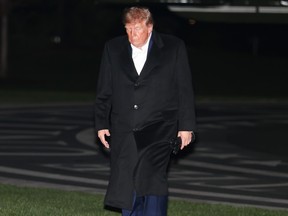
President Donald Trump is expecting the U.S. trade war with Canada to end “pretty soon.”
Sign In or Create an Account
At a rally in Port Huron, Michigan on Sunday, he repeated his allegation that Canada had been “ripping off” the U.S., giving him no choice but to impose levies on Canadian goods.
He backed up his conclusion that the trade war will soon resolve by asserting Canada was “willing to give us anything at this moment,” reported the Canadian Press.
Canada-U.S. ties have been strained since the Carney government walked away from trade talks in August, citing unreasonable last-minute demands from the Americans.

Get a dash of perspective along with the trending news of the day in a very readable format.
By signing up you consent to receive the above newsletter from Postmedia Network Inc.
A welcome email is on its way. If you don't see it, please check your junk folder.
The next issue of NP Posted will soon be in your inbox.
We encountered an issue signing you up. Please try again
“Canada has been ripping off the United States for years, OK? For years. And I had to do it. We’ll have that settled pretty soon. They’re willing to give us anything at this moment,” Trump said Sunday.
Trump’s trade war with Canada has been a key issue ahead of the U.S. midterm elections in November, especially amid tight races. With the election day less than two weeks away, Trump announced Friday he will lift some of those 50 per cent tariffs at the end of the month, while adding tariffs to dozens of new products.
The shift came at the request of Republican Senator Susan Collins of Maine, an eastern state on the Canada-U.S. border hit hard by the trade dispute.
Meanwhile, White House economic adviser Kevin Hassett also said on Sunday that a trade deal was close, Bloomberg reported.
“I think it’s very close,” Hassett, director of the White House National Economic Council, said, adding that Commerce Secretary Howard Lutnick had been speaking with Canadian officials throughout the week.
However, there has been no confirmed breakthrough. Canada-U.S. Trade Minister Dominic LeBlanc’s office said the government will assess the latest tariff measures and that “Canada stands ready to work constructively and in good faith towards a more mutually beneficial trading relationship” with the U.S.
The latest comments from Trump and Hassett, were preceded by Trump claiming last Friday that Canada was “working very hard” to make a trade deal with the U.S.
However, Prime Minister Mark Carney said during a press conference on the same day that Canada “could sign it this afternoon if the U.S. were there. If it has to be months from now or longer than that, or another administration before a proper deal comes into place, we will do that,” National Post reported. When asked whether Canada could sign a deal with the Americans before the U.S. midterms, Carney did not close the door on that possibility, but he said the U.S. is “hard to predict.”
Trump is facing pressure about the tariffs from several fronts. For example, the levies on steel and aluminum have been a “disaster” for the U.S. economy, fueling inflation and failing to spark promised growth in those industries, according to a recently released think tank report, National Post previously reported.
The Montreal Economic Institute found that steel and aluminum prices in the U.S. market have soared since Trump placed tariffs on those two industrial sectors but have failed to create new jobs. These two sectors provide key inputs in a wide variety of other products, the report found, and they have also become more expensive. The ongoing dispute has left consumers and industrial buyers facing higher price tags on autos, aircraft, construction, machinery, and a wide range of other products.
On another front, the Trump administration is being sued over the imposition of 50 per cent tariffs on an array of Canadian goods. The lawsuit, filed in mid-October, argues that Trump lacks the authority to invoke a never-before-used section of U.S. law to impose levies against Canada, and further, that this is part of a trend of unlawful tariff impositions by the administration.
The challenger, Gellert Global Group Corp., specializes in food imports, including Canadian cheese.
In fact, Trump has faced a slew of legal challenges to his tariff policies. The U.S. Supreme Court struck down his first attempt at global tariffs last year under an economic emergency powers law, a loss that has forced customs authorities to refund the US$166 billion collected from importers, plus interest.
During an Oct. 17 rally in Kentucky, Trump took a swipe at former prime minister Justin Trudeau as well as Canada’s health care system in a rant.
“You know, we had Trudeau, who’s not a good — not a good guy — loser,” Trump said.
Possibly referring to Mark Carney, he added Canada’s “current guy’s good … but he’s not nice when it comes to trade … For years we’ve lost billions and billions of dollars, and they just felt so emboldened.”
Trump also raised another claim that the U.S. is “losing” US$90 billion to Canada. That money funded Canada’s “health-care system and other things that they shouldn’t be having. They spend money — they spend our money very unwisely.”
During the rally, he said a trade deal with the country would land “at some point. We’re making a deal that’s gonna be amazing.”
Trump has previously stated the U.S. does not need “anything” from Canada.
Kentucky is among the hardest-hit states by Canadian retaliatory tariffs. They were applied on more than 700 U.S. products entering Canada — covering CA$27.6 billion in annual imports, National Post reported. Several U.S. states will feel the impact, including Ohio, Illinois, Indiana, Kentucky, Tennessee, Texas, and Maine.
However, Michigan could take the hardest hit. It ships about $1.5 billion in tariff-listed products to Canada each year. Canada was the destination for 36 per cent of Michigan’s goods exports in 2025, according to U.S. trade data, and motor vehicles and auto parts accounted for a large share of that.
Michigan Republican Senate candidate Mike Rogers broke ranks with Trump in early October by saying in a campaign ad that the trade war with Canada needs to end. In a campaign ad, Rogers said: “Here in Michigan, we know that Canada is not our enemy. We need to end this tariff war now.
Trump’s tariff fight and Ottawa’s retaliation could certainly exact political costs on Trump and Republicans in November’s midterms, National Post previously reported. A survey released at the end of September by the Cato Institute found that 75 per cent of registered U.S. voters said tariffs, defined in the poll as a U.S. tax imposed on imported products, would be important to their vote.
While few issues draw bipartisan backing, Democrats were not alone in feeling challenged by Trump’s tariffs. According to the Cato Institute, nearly two-thirds of Republicans also said tariffs imposed under Trump had increased prices.
Our website is the place for the latest breaking news, exclusive scoops, longreads and provocative commentary. Please bookmark nationalpost.com and sign up for our daily newsletter, Posted, here.
Join the Conversation
This website uses cookies to personalize your content (including ads), and allows us to analyze our traffic. Read more about cookies here. By continuing to use our site, you agree to our Terms of Use and Privacy Policy.
KioskNews shows a cleaned-up reading view extracted from the publisher’s page — the original always lives on their site, not ours.