Jamie Sarkonak: Galloway trial going poorly for defendant who chose to represent herself
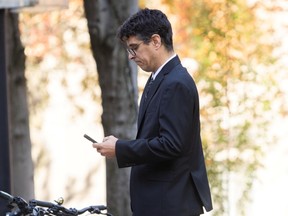
If anything is to be learned from the cross-examination of Steven Galloway, it’s that you should never represent yourself in court when being sued for defamation.
Sign In or Create an Account
All week, the former professor and author has been answering a barrage of questions before the B.C. Supreme Court about what he testified the week before. The point of this cross-examination is to give the defendants a fair opportunity to draw out evidence to assist their case, to test the evidence that hinders their case, and to find any contradictions in Galloway’s story that may poke holes in his credibility.
This trial has been years in the making: it was back in 2015 that Galloway’s career was destroyed by sexual assault allegations from his former paramour, which blew up into national news. Though the allegations were never proven, and indeed were found to be unsubstantiated by a former judge who investigated the matter, Galloway was fired from the University of British Columbia, branded a rapist, and was rendered unable to write and publish more books. Galloway has testified that the sexual assault allegations were baseless, and his accuser isn’t going to assert that her claims were true in court.

Columnist Jesse Kline keeps you up to date with what’s happening in Israel and the effects of antisemitism on life here in Canada. Friday mornings.
By signing up you consent to receive the above newsletter from Postmedia Network Inc.
A welcome email is on its way. If you don't see it, please check your junk folder.
The next issue of Channel Israel will soon be in your inbox.
We encountered an issue signing you up. Please try again
In 2018, he sued the woman who accused him of rape, who can be identified only as A.B. due to a publication ban, and numerous others who repeated and amplified her claims. The vast majority of these individuals settled with Galloway out of court, with only four defendants proceeding to trial.
Two defendants are represented by lawyers, who grilled Galloway on Friday, Tuesday, and half of Wednesday. One defendant hasn’t shown up at all. And the final defendant, Glynnis Kirchmeier, decided to represent herself — and is clearly struggling.
Kirchmeier began her questioning partway into Wednesday, but was halted so frequently by Justice Neena Sharma and by objections from Galloway’s lawyer that she was unable to finish by the evening, despite the court sitting longer than originally scheduled.
It was evident very quickly into her attempt at cross-examination that Kirchmeier was out of her depth. Among her initial questions to Galloway was whether he thought it was defamatory for her to call him a “sexual harasser.” Whether a statement is defamatory or not is a legal question for the judge to answer alone; it was an inappropriate question to put to Galloway, and Justice Sharma cut Kirchmeier off immediately. Adding to the confusion, Kirchmeier is attending trial by video link.
Kirchmeier was a graduate student at UBC from 2011 to 2013 and is now a law student. Her involvement in Galloway’s case is best summarized in a 2021 pre-trial decision: in 2015, she participated in a CBC documentary about sexual assault in universities, in particular with regard to allegations in UBC’s history department. The next year, she struck up a connection with A.B.
Then, in 2018, Kirchmeier posted the tweet that got her sued. Criticizing a Walrus article that mentioned Galloway’s affair with A.B., she wrote, “That piece said Galloway had an ‘affair,’ which we now know is what he calls raping/sexually harassing a student.” Galloway was found by the judge who investigated his case to have committed sexual harassment per university policy, but he was cleared of sexual assault and maintains that no rape ever happened.
In her defence, Kirchmeier is planning to argue that her statement was a fair comment on a matter of public interest. However, the judge handling pre-trial affairs in 2021 opined that this defence wasn’t available to her (that judge said she should have gone with the defence of truth instead). On Wednesday, Justice Sharma remarked that Kirchmeier seemed to be putting together a truth defence rather than a fair comment defence, which was inappropriate given her pleadings.
On Wednesday, Kirchmeier quizzed Galloway on his understanding of university policy, of his familiarity with her Twitter account, and of the investigation that a former judge made into his case, among other things. Aside from being halted frequently by Justice Sharma for raising irrelevant lines of questioning, she also received a few objections from Galloway’s lawyer, Daniel Burnett, for attempting to bring in “bad act evidence” — that is, trying to use past unrelated behaviour to attack Galloway’s credibility. Initial gentle warnings from Justice Sharma went unheeded, causing them to grow into terse instructions to stop. While seasoned lawyers know where the boundaries of cross-examination are, Kirchmeier is demonstrably blind.
Making matters worse, Galloway’s lawyer told the court that he intends to use any bad conduct by the parties at trial to bolster his claim for damages. Kirchmeier is not only holding up the trial process and fumbling her case by not engaging a lawyer; she is also opening herself up to an even greater penalty in the end.
Court reconvened Thursday to allow Kirchmeier to get through her questions. Next week, more plaintiff witnesses are scheduled to take the stand.
The rest of cross-examination flowed far more easily, though it was not without its hiccups. Counsel for Mandi Gray, a sociology professor who is being sued for several past tweets dragging Galloway, questioned the author about his collapsed book deal. The next morning, Gray’s lawyer alerted the judge that she had new documents showing that Gray had in fact emailed A.B. to discuss a boycott of Galloway’s publisher, an item he had never seen before.
Cross-examination by A.B.’s lawyer, Arden Beddoes, focused largely on Galloway’s revenue from book royalties and other writing-related income. He was forceful in trying to catch Galloway on contradictions regarding his story. At one point, Galloway asked Beddoes not to roll his eyes at him, prompting a quick apology from the lawyer for the “eye-jerk reaction.”
National Post
Join the Conversation
This website uses cookies to personalize your content (including ads), and allows us to analyze our traffic. Read more about cookies here. By continuing to use our site, you agree to our Terms of Use and Privacy Policy.
KioskNews shows a cleaned-up reading view extracted from the publisher’s page — the original always lives on their site, not ours.