FIRST READING: Mark Carney’s left-wing enemies
First Reading is a Canadian politics newsletter curated by the National Post’s own Tristin Hopper. To get an early version sent directly to your inbox, sign up here.
Sign In or Create an Account
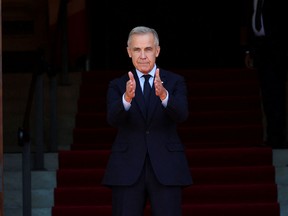
As Prime Minister Mark Carney continues to enjoy a sustained run of popularity, it’s been accompanied by a slew of policies typically only discussed in conservative circles.
These include tax cuts to fuel and income, a massive buildup of the Canadian Armed Forces, the proposed privatization of Canadian airports and new legislation making it easier to push through resource projects and order striking employees back to work.
One of the consequences is that Carney is now facing the kind of activist pushback that was largely unknown to his immediate predecessor, Justin Trudeau. Below, a cursory guide to Carney’s left-wing enemies.

Columnist Jesse Kline keeps you up to date with what’s happening in Israel and the effects of antisemitism on life here in Canada. Friday mornings.
By signing up you consent to receive the above newsletter from Postmedia Network Inc.
A welcome email is on its way. If you don't see it, please check your junk folder.
The next issue of Channel Israel will soon be in your inbox.
We encountered an issue signing you up. Please try again
David Suzuki and the climate movement
Environmentalism was Carney’s full-time job only a few years ago. He was the United Nations Special Envoy on Climate Action and Finance, wrote a whole book about climate policy and ran a climate-based investment consortium that spun apart soon after he left to join Canadian politics.
So it’s been somewhat destabilizing to climate activists that Carney’s agenda has included a number of items they have traditionally despised, such as oil pipelines and ramped-up natural gas production.
Ecojustice is suing the Carney government on the grounds that it isn’t meeting its own carbon emissions targets. The group’s press release made clear it was taking on someone previously considered a friend. “Before entering politics, Carney built an international reputation as one of the world’s most influential voices on climate-related financial risk,” it read.
This week, the godfather of Canadian environmental activism, David Suzuki, said Carney is driving Canada into a “ditch,” adding “I think we’re kind of hooped.”
Although, Suzuki doesn’t have a lot of experience getting along with politicians. In 2015, Trudeau was only a few weeks into the job as prime minister before he had a falling-out with Suzuki, accusing the former Nature of Things host of “sanctimonious crap” before hanging up the phone.
Health care absolutists
The Ottawa-headquartered Canada Health Coalition is one of the more uncompromising defenders of the Canadian health-care regime, including the uniquely Canadian provision banning private insurance coverage for any procedure covered by the Canada Health Act.
When Trudeau resigned in early 2025, the CHC warned that without him, the future of two NDP-brokered health programs – pharmacare and the Canadian Dental Care Plan – could be in jeopardy.
They were partially right; Carney phased out pharmacare, but kept a version of the dental plan.
This month, the CHC has been busy picketing the offices of Liberal MPs in eight provinces. The reason? Alberta has introduced legislation to make it easier for doctors to work in both private clinics and the public system (currently, they’re required to pick one). And the CHC wants Carney to bring the hammer down on what they call “the spread of two-tier, U.S.-style health care.”
Generalized anti-capitalists
Earlier this month, Carney held his Canada Investment Summit in Toronto, pitching international financiers on a list of pre-approved, shovel-ready resource projects. And the event attracted an estimated 1,000 protesters.
The theme of the protest was kind of all over the place, but it included the environmental group Dogwood, World Beyond War and Common Horizon, a group opposing “corporate greed.” Various labour unions and Indigenous organizations also sent representatives.
Common Horizon, for its part, said their members showed up because Canada is increasingly poorer and afflicted by toxic air and water, which is why Carney needs to “invest in us, not put our country up for sale for the ultra-rich.”
Organized labour
Labour unions – particularly public sector ones – will usually come around to fighting any government in power, even if it’s NDP.
But in just the last month, several events have aligned to make Carney a particularly potent bogeyman for organized labour.
Carney’s plan to privatize four Canadian airports incensed the Union of Canadian Transportation Employees, who told him that they’re not for sale. “Selling a stake in our airports, whether to foreign or domestic investors, is not in the interest of the travelling public,” read a Sept. 15 statement.
And then Carney’s newly tabled Building Canada Strong Act really galvanized union opposition because of its provisions streamlining Ottawa’s ability to order federal employees back to work if their strike runs counter to the “national interest.”
The Canadian Labour Congress, which has supported a lot of Carney’s efforts on trade thus far, responded to the bill saying “we cannot have our elbows up against Trump with our hands tied behind our backs at the bargaining table.”
Migrant activists
Migrant activists began targeting Liberals in late 2024 after then Prime Minister Justin Trudeau promised to “turn off the taps” of a post-COVID spike in temporary migration higher than anything in the country’s history.
In one particularly notable encounter, then Immigration Minister Marc Miller told a House of Commons committee that he expected Canada’s non-permanent residents to leave the country voluntarily – only to be immediately confronted outside by activists telling him they would do no such thing.
“Mr. Miller, we are the people you are trying to kick out of the country. We are human beings and we are not taps to be turned on and off,” said a representative with the Migrant Workers Alliance for Change as Miller pushed past him.
Carney has continued to pursue reductions in student visas and other temporary migration streams, with the result that groups such as the Migrant Rights Network and the Canadian Council for Refugees have continued to frame his government as cruel deportationists.
The Migrant Rights Network, in particular, seeks immediate permanent status for anyone currently in the country, and accuses the Carney government of abandoning them to “wage theft, unlivable homes, abuse and mistreatment that threatens their wellbeing and our collective society.”
Anti-militarists
One of the more defining features of the Carney government is how it has opened the floodgates on military spending. The Department of Defence has effectively been running on a shoestring since the 1990s, but Carney has nearly doubled its budget overnight.
Just as the House of Commons was reopening this week, a small delegation of women’s peace activists held a press conference on Parliament Hill to denounce the “dangerous” and “carbon-intensive” expansion of the Canadian Armed Forces.
“We are opposed to the federal government’s plan to rebuild, rearm and reinvest in the Canadian military,” said Tamara Lorincz with the Canadian Voice of Women for Peace. Also in attendance was the Women’s International League for Peace and Freedom-Canada.
Lorincz said the military is an “environmentally destructive” organization, and that all the new spending was “accelerating poverty and ecological breakdown and leading to a global war.”
Two days ago, this newsletter suggested that B.C. Premier David Eby’s decision to call a snap election could blow up in his face. And now, the first poll conducted since the campaign started has appeared to confirm this is indeed what’s happening.
The campaign still has four weeks to go, and according to the Angus Reid Institute Eby is already running at an eight-point disadvantage to his newly reconstituted B.C. Conservative opposition.
Although Eby held a slight lead over the B.C. Conservatives on the day he dissolved the legislature, voter intent is now at 43 per cent B.C. Conservative, 35 per cent NDP. If the numbers hold, this almost certainly means the loss of Eby’s majority in favour of victory by the B.C. Conservatives.
One of the more telling indicators of the campaign is that several senior members of Eby’s caucus have stated they will not be running for re-election, including four of his ministers.
In the leadup to the 2025 federal election, caucus resignations turned out to be one of the more reliable signals as to which way the wind was blowing. As Liberal fortunes plummeted under then Prime Minister Justin Trudeau, it prompted a historic exodus of retirements from his cabinet, several of whom said they were leaving to spend more time with their family.
Then, when poll numbers began to recover under Mark Carney, some of those cabinet members suddenly returned.
First Reading is a Canadian politics newsletter curated by the National Post’s own Tristin Hopper. To get an early version sent directly to your inbox, sign up here.
Join the Conversation
This website uses cookies to personalize your content (including ads), and allows us to analyze our traffic. Read more about cookies here. By continuing to use our site, you agree to our Terms of Use and Privacy Policy.
KioskNews shows a cleaned-up reading view extracted from the publisher’s page — the original always lives on their site, not ours.