Netanyahu bloc leading in Israel election with more than half of votes tallied, but short of a majority
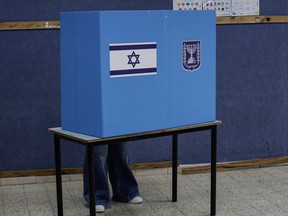
Israeli Prime Minister Benjamin Netanyahu edged past opposition leader Gadi Eisenkot in the country’s tight election with more than 70 per cent of the votes counted, though neither yet has a clear path toward forming a government.
Sign In or Create an Account
Netanyahu’s bloc was projected to win 54 seats and Eisenkot’s 47 in the 120-member Knesset, or parliament, as of Wednesday morning, with 19 going to Israeli Arab parties. That was a starkly different tally from exit polls hours earlier, which showed the two sides neck and neck.
The vast majority of the polling station votes were expected to be counted today, but hundreds of thousands of other votes, from army bases, hospitals and diplomatic outposts, won’t be tallied for another day or two. In the past, those have trended to the right.

Columnist Jesse Kline keeps you up to date with what’s happening in Israel and the effects of antisemitism on life here in Canada. Friday mornings.
By signing up you consent to receive the above newsletter from Postmedia Network Inc.
A welcome email is on its way. If you don't see it, please check your junk folder.
The next issue of Channel Israel will soon be in your inbox.
We encountered an issue signing you up. Please try again
Netanyahu and Eisenkot both expressed confidence they would be the next leader, though it will be days before President Isaac Herzog chooses who gets the opportunity to cobble together a majority coalition. Should neither succeed, another election could take place in several months.
Israeli assets slid across the board amid the election uncertainty. The shekel depreciated about one per cent against the dollar, the most in two weeks, having risen sharply on election day. The benchmark stock index in Tel Aviv was down 2.1 per cent. Israel’s dollar bonds underperformed emerging-market peers.
Netanyahu, 77, appeared on stage around 3:15 a.m. local time, saying his rightist bloc has “a clear, decisive majority.” He appeared jubilant and finished his speech in Jerusalem by calling officials from his Likud party on to the stage to sing the national anthem.
He talked up his relationship with U.S. President Donald Trump and said the two of them would “remove this threat” of Iran, again suggesting another round of bombing against the Islamic Republic could be close.
Eisenkot, a 66-year-old former general, spoke beforehand and described Netanyahu’s current far-right government as “the coalition of failure” that had “lost the people’s trust.”
“We have made history,” he said. “The public has voted for change,” adding that it would be a mistake to go to a second round of voting.

Netanyahu’s Likud looks set to be the biggest single party — even though it likely won fewer seats than in the last election in 2022 — with Eisenkot’s Yashar in second place.
Traders on prediction markets had consistently given Eisenkot a higher chance of becoming the next leader since mid-July. But that changed in the early hours of Wednesday, with Polymarket suggesting Netanyahu’s odds had climbed to 55 per cent and Eisenkot’s had dropped to 27 per cent.
Israel’s two Arab parties have emerged as potential kingmakers, representing a bloc that would give either side a significant majority. Both have indicated they would back Eisenkot in some form, having rallied supporters to help oust Netanyahu and prevent a new term they believe would pose an existential threat.
However, two of Eisenkot’s fellow bloc leaders have said they’d refuse to serve in a government with the Arab parties, especially if they decline to declare Hamas a terrorist organization and Israel a Jewish state.
Voter turnout was close to record highs throughout the day, reaching about 78 per cent shortly before 10 p.m., when voting ended, according to the central elections committee.
Should Eisenkot succeed in becoming prime minister, it would mark a stunning defeat for Netanyahu, who has dominated Israel’s politics for much of the past three decades and led the country through three years of near-constant war since Hamas’ attack on Oct. 7, 2023.
Many Israelis blame him for failing to prevent, and subsequently take responsibility for, the Hamas assault on Israel that was the deadliest day in the Jewish state’s history. Netanyahu has since waged military campaigns in Gaza, Lebanon, Syria and against Iran, which he and his supporters say have made the country safer.

“The public has spoken — it has fired the Netanyahu government,” Yair Golan, leader of the leftist Democrats Party and part of Eisenkot’s bloc, said in a statement, reflecting the premature sense of play late last night. “We represent an enormous constituency that has spent four years fighting in the streets. We are ready to work with our partners, bridge differences and take responsibility.”
The makeup of any new government will take days or weeks to finalize, with Netanyahu remaining prime minister in the meantime. That would enable him to join Trump in renewed strikes on Iran after the U.S. midterms next week, as both have repeatedly threatened.
Trump had endorsed Netanyahu, saying the incumbent had what it takes to “finish the job” in the eight-month war with the Islamic Republic. In a social media post, he took credit for pushing Netanyahu out ahead.
Eisenkot pitched himself as a more modest alternative to Netanyahu, while still emphasizing a commitment to resolving Israel’s myriad security challenges. On Iran, he has said the country’s nuclear program must be curbed, militarily if necessary, but that regime change in Tehran is “not an achievable goal.”
No party in Israel’s history has won an outright election majority, requiring often long periods of coalition negotiations.
Beyond national security, voters cast ballots on a set of domestic issues — including whether to draft ultra-Orthodox young men into the army. The power of the Supreme Court and judicial system, which Netanyahu has sought to undermine, transparency and corruption are also on the agenda.
For Palestinians in Gaza and the occupied West Bank, where violence by Jewish settlers on Arabs has soared since the Hamas incursion, the election is unlikely to lead to any immediate changes. Like Netanyahu, Eisenkot has ruled out a two-state solution, saying it would threaten Israel’s security, though he’s condemned the government for supporting Israelis who have attacked Palestinians.
The economy has mostly taken a back seat. Israel has proved resilient in the face of multiple wars, with the shekel and the stock market outperforming most rich-world peers this year. Still, whoever leads the next government will have to deal with issues ranging from a soaring defence budget to rising sovereign debt levels and one of the world’s highest costs of living.
— With assistance from Galit Altstein, Yasufumi Saito, Tom Fevrier, Vivien Ngo and Carla Canivete.
Our website is the place for the latest breaking news, exclusive scoops, longreads and provocative commentary. Please bookmark nationalpost.com and sign up for our newsletters here.
Join the Conversation
This website uses cookies to personalize your content (including ads), and allows us to analyze our traffic. Read more about cookies here. By continuing to use our site, you agree to our Terms of Use and Privacy Policy.
KioskNews shows a cleaned-up reading view extracted from the publisher’s page — the original always lives on their site, not ours.