LTA proposes merging COE car categories, with fees and rebates for different models
SINGAPORE: The Land Transport Authority (LTA) has proposed merging categories A and B Certificates of Entitlement (COEs) for cars into a single category, and to introduce surcharges and rebates pegged to a car’s open market value.
Under the proposed fee-and-rebate system, the maximum price difference between a higher-end car and a mass-market car would be S$30,000 (US$23,000).
This means that buyers of higher-end electric vehicles (EVs) who currently pay Category A premiums, which have traditionally been lower than in Category B, could pay more as a result.
A public consultation for the proposal opened at 5pm on Thursday (Oct 8) and will end at 11.59pm on Nov 2. LTA will share its findings and recommendations by the first half of 2027.
Categories A and B have traditionally segmented the market for cars into smaller, less powerful models and larger, more powerful ones, based on engine capacity and power.
“However, advances in vehicle technology, particularly with the advent of EVs, have made these criteria less effective, with manufacturers increasingly able to adjust vehicle specifications to fit within existing Category A thresholds,” LTA said in a media release.
This has increased competition in Category A and narrowed its price gap with Category B. Category A premiums exceeded Category B premiums three times between February and June this year.
In the latest bidding exercise on Wednesday, Category A premiums closed at S$130,001 and Category B at S$130,100.
“The objective of the public consultation is to seek views on how to more effectively distinguish between mass-market and higher-end cars in the COE system, while allowing COE prices to continue to be determined by market forces,” said LTA.
It comes after Transport Minister Jeffrey Siow said at the ministry’s Budget debate in March that he had asked LTA to review the issue.
The agency engaged more than 200 members of the public, academics and automotive industry representatives on their suggestions for the COE system, which allocates vehicle quotas to control traffic congestion in Singapore.
"As vehicle technology and the vehicle market continue to evolve, it is timely to review whether the current categorisation of cars remains fit-for-purpose. Through this consultation, we invite the public to share their views on the proposed changes and trade-offs involved," said LTA chief operating officer Lim Zhijian.
HOW IT WOULD WORK
After the merger of the two categories, each car's COE price would be adjusted by a rebate or surcharge if necessary, based on the median open market value of the car model.
The open market value is the cost of a vehicle imported into Singapore as assessed by Singapore Customs, taking into account the purchase price, freight, insurance and all other sale and delivery charges for importing the car.
This value is currently used to calculate a car’s Additional Registration Fee.
The median open market value would be based on past registrations of the same model over a set period, such as the past year. The percentile into which that median falls would then determine which fee or rebate band applies to the car.
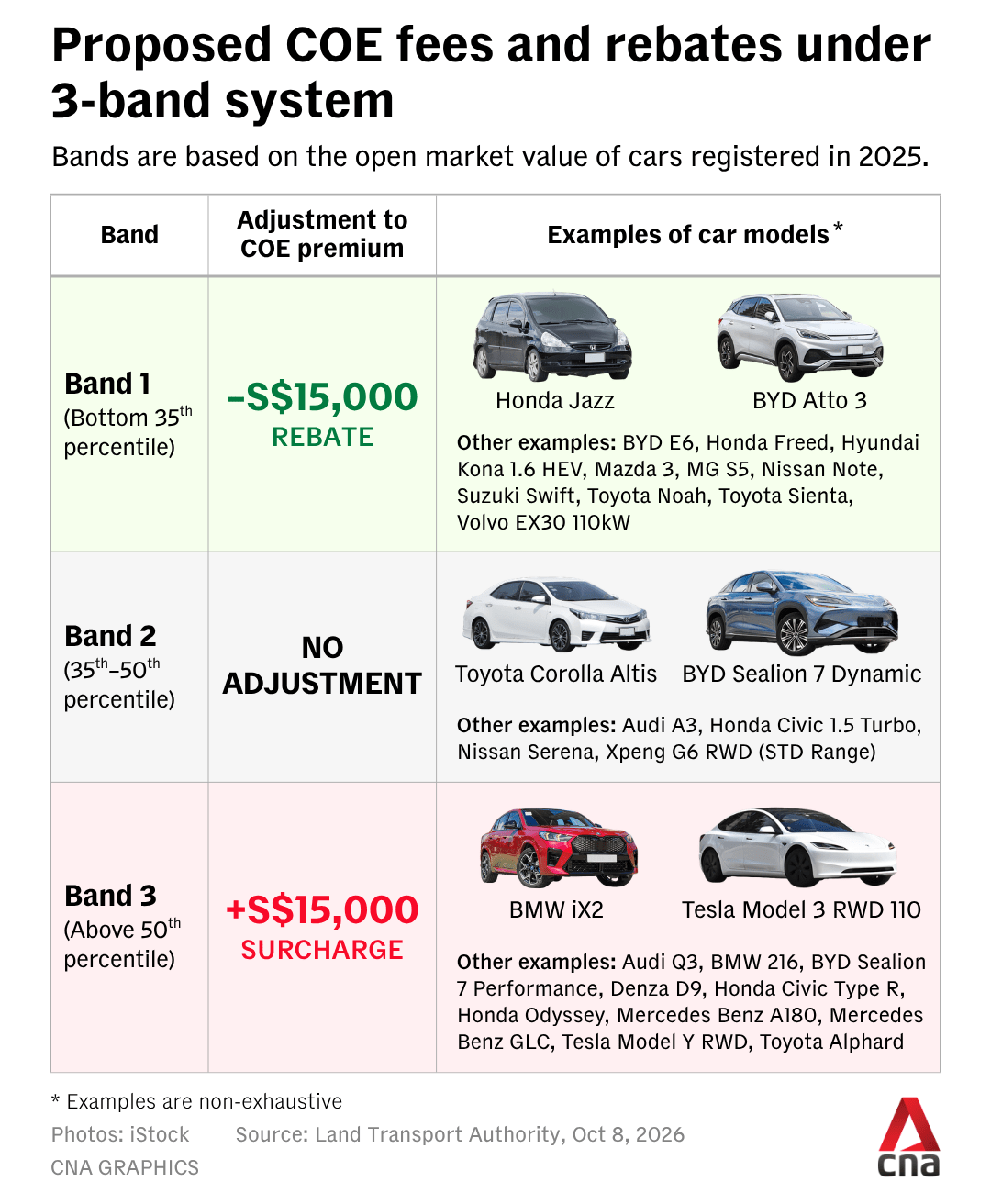
The consultation paper outlines two possible structures. A three-band structure would have a S$15,000 rebate band, a middle band with no adjustment and a S$15,000 surcharge band.
This would be simpler to administer but adjustments between adjacent bands would be larger, LTA said.
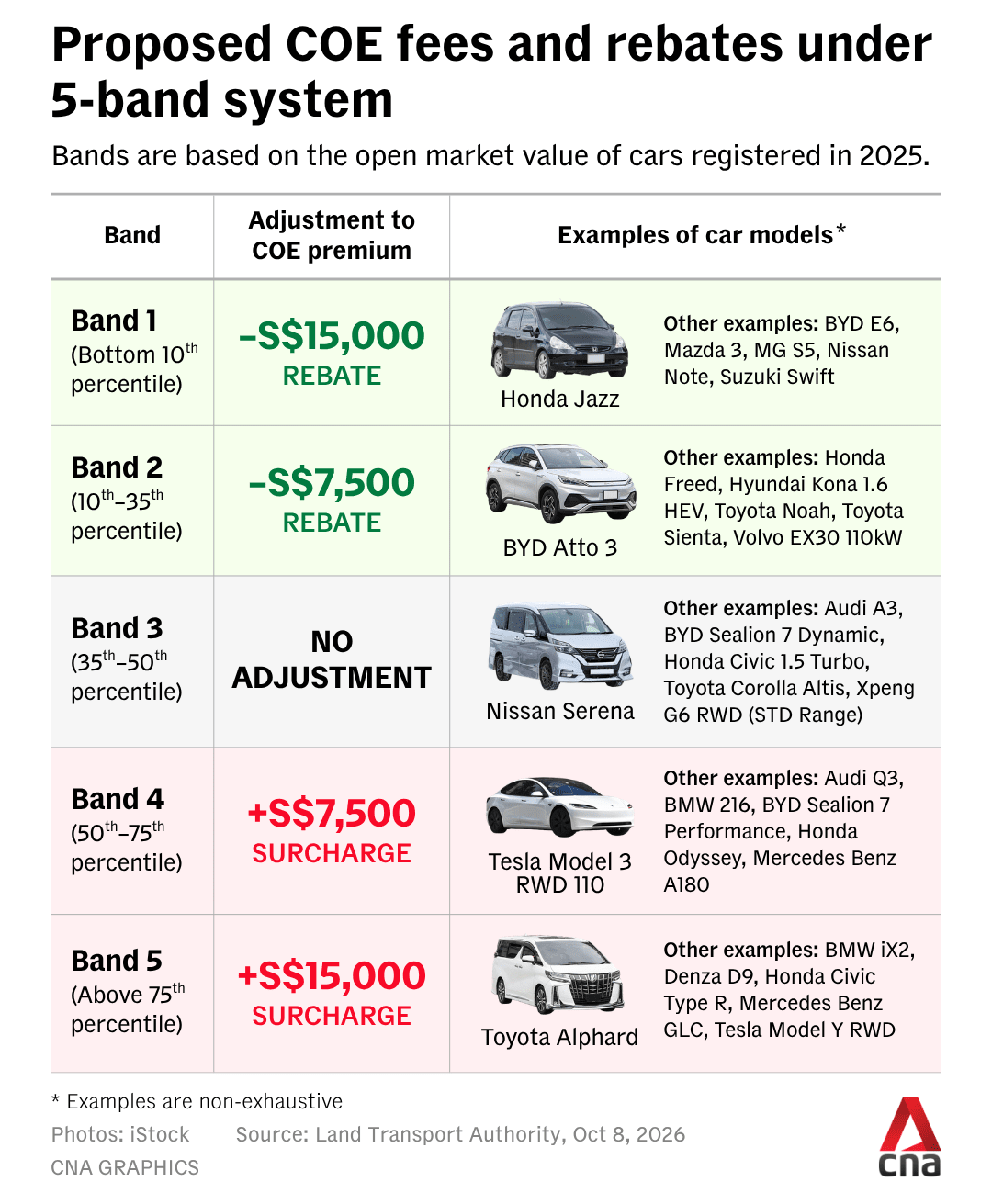
A five-band structure would more finely differentiate car models into S$15,000 or S$7,500 rebate bands, a middle band with no adjustment, and S$7,500 or S$15,000 surcharge bands.
This would reduce the difference in treatment between comparable cars in adjacent bands, but make administration more complex, LTA said.
LTA said it would review and publish the band for each car model annually to keep buyers informed before they decide on their purchases.
Car retailers would be able to appeal a band assignment.
LTA also sought views on whether the fee-and-rebate system should apply to COE renewals.
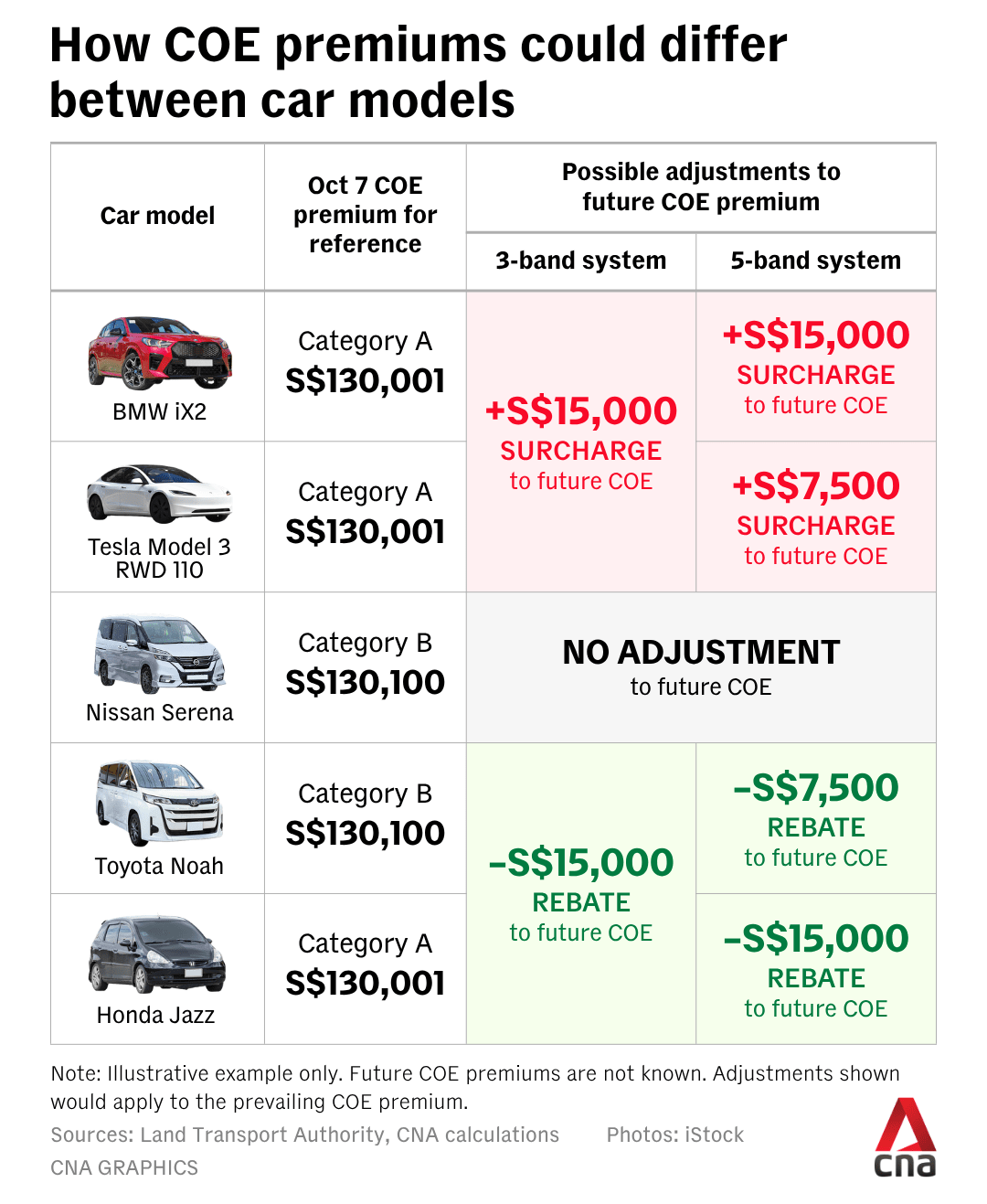
Asked at a media briefing how the rebate and surcharge amounts were set, LTA told reporters that this involved a judgment of what would be a meaningful price difference between mass-market and higher-end cars.
Based on historical data, the general difference between Category A and B prices has been about S$20,000 to S$30,000, notwithstanding the convergence in recent years, said the agency.
Had the system applied to the 52,678 cars newly registered in 2025, about half would have received a rebate or no change, while the other half would have faced a surcharge.
In considering the appropriate rebate and surcharge amounts, one possible reference point is the historical price gaps between Category A and Category B. This provides an indication of the difference in COE premiums that buyers of the two groups of cars have historically been willing to pay under the existing system.
WHAT HAPPENS TO CATEGORY E?
LTA also sought views on whether and how open category COEs – Category E – should change if cars only have one category.
Category E COEs can be used to register any vehicle except motorcycles. Their supply comes from 10 per cent of deregistrations from categories A and B for cars, and Category C for goods vehicles and buses.
The category is meant to accommodate changes in demand for different vehicle types. As these COEs are transferable, they are also sought by buyers who urgently need to register a vehicle without waiting for the next bidding exercise.
Bidders typically use open COEs to register vehicles in the category with the highest premium. In recent years, this has been mostly Category B cars, said LTA.
If categories A and B are merged, the open category would change from registering vehicles in three categories – two for cars and one for goods vehicles and buses – to registering vehicles in two categories – one for cars and one for goods vehicles and buses.
Category E would continue to be used mainly for cars, “at the expense” of goods vehicles and buses, said LTA.
LTA said one suggestion from focus group discussions was to scrap Category E to simplify the system, but it pointed out that this would adversely impact buyers who urgently need a car.
An alternative is to keep Category E for cars only, which would preserve those buyers' options without affecting Category C supply, it said.
NEEDS-BASED COE AND OTHER SUGGESTIONS
LTA also addressed other suggestions about the COE system raised in focus groups.
One suggestion was to give families with young children more support with car ownership. Similar calls have been made in parliament.
LTA said the key question was how to support families’ needs while preserving a COE system that is “market-based, equitable, and transparent”.
Allocating COEs by household circumstances requires judgment about whose needs should receive greater priority, said the agency. For example, more COEs for families with young children would mean fewer COEs for caregivers and multi-generational households.
Household circumstances also change over time, making it difficult to administer such a system fairly over the lifespan of a COE, said LTA.
The agency is instead working out the details of a transport grant to help offset the transport costs of large families with three or more Singaporean children, whether by taxi or public transport.
LTA also addressed the suggestion of imposing a surcharge on those who own more than one car, similar to the Additional Buyer’s Stamp Duty for residential properties.
It said multiple-car owners are not a key driver of COE demand, and a surcharge would be unlikely to significantly affect prices and difficult to administer fairly.
Last year, about 66,000, or 13 per cent, of car-owning households had more than one car, down from 87,000, or 19 per cent, in 2012.
Focus group participants also suggested creating a separate COE category for private-hire cars. But this would require quota to be taken from categories A and B, LTA said.
Too few COEs could cut the supply of private-hire cars and raise rental rates and fares, while too many could shrink the pool for private buyers and push up COE prices.
Private-hire cars are used for both ride-hail services and personal journeys, so a separate category would also need additional regulation to keep vehicles to their intended use.
Another suggestion was to ban motor dealers from bidding for COEs on behalf of their customers.
Rather than restricting who can bid, LTA said it was looking to encourage individual bidders by allowing them to make their initial bid online and reviewing the fees for making and revising bids.
The authority said it was also looking at ways to get motor dealers to publish unbundled car prices without COE to improve price transparency for individual buyers, who could compare prices and buy cars directly with their own COEs.
Some participants suggested changing the way the COE price is set to a pay-as-you-bid system.
The COE clearing price is currently set at the highest unsuccessful bid plus S$1, and all successful bidders in the category pay the same price.
In a pay-as-you-bid system, each successful bidder would pay the amount they actually bid. Participants believed this may encourage more conservative bids and lower COE prices.
LTA pointed out that COE bidding is an open auction, so bidders can observe the prevailing price and revise their bids during the exercise.
“Even if bidders were to pay what they bid, a rational bidder would always bid marginally above the prevailing price. This would be no different from the current system,” it said.
Most bids already cluster around the clearing price. About three in four successful Category A and B bids in 2025 were within 5 per cent of it. Among all bids, including unsuccessful ones, about two in three were within 5 per cent above or below it.
KioskNews shows a cleaned-up reading view extracted from the publisher’s page — the original always lives on their site, not ours.