No island of strangers: why I’m using art to unite a fractured nation
One of the moral low points of Keir Starmer’s tenure at Downing Street was his “island of strangers” speech, with its rhetorical echoes of Enoch Powell and dispiriting description of a nation fractured by difference. After widespread criticism, Starmer recanted his words, if not the sentiment behind them. Yet his choice of language was a reminder of how the idea of the stranger – representing immigration, but also wider, more inchoate anxieties about otherness and difference – holds such a potent place in Britain today.
In fact, from masked anti-migrant protesters on the south coast to xenophobic riots over the summer, from politicians vowing to stop the boats to immigration polling as the No 1 concern among UK voters, it’s probably true to say that fear of the stranger is the totemic issue of our times.
Not long after Starmer’s speech, I was appointed curator of the British Art Show, which opens in Coventry this week. My thoughts have turned increasingly to the notion of the stranger among us as I’ve worked on the exhibition. The show, developed and produced by Hayward Gallery Touring, is the largest and most significant recurring exhibition of contemporary art in the UK.
Founded in 1979, the exhibition takes place every five years, touring across the country to offer a snapshot of the ideas and ambitions of a rising generation of artists born or based in Britain. Previous versions have brought the likes of David Hockney, Bridget Riley and Anish Kapoor to national audiences. This year is the 10th edition and it features a lineup of critically lauded artists including Alvaro Barrington, Lindsey Mendick and recent Turner prize winners Jesse Darling and Jasleen Kaur.
Each new iteration prompts the same question: what does the show say about British art? Or, indeed, about Britain? In the context of the globe-spanning fairs, biennales and mega-galleries that make up today’s contemporary art world, the question is possibly antique. Yet an exhibition tasked with addressing recent developments in art will inevitably reveal something about the country in which that work originates. To talk about British art, then, is also to talk about place and belonging. It is to ask who we are as individuals, as communities and as a nation.
I’ve chosen to give the latest exhibition a subtitle: A Chorus of Strangers. The name is not a reference to Starmer’s speech, but it does gesture back to another much earlier period in British history also characterised by its antipathy to outsiders.
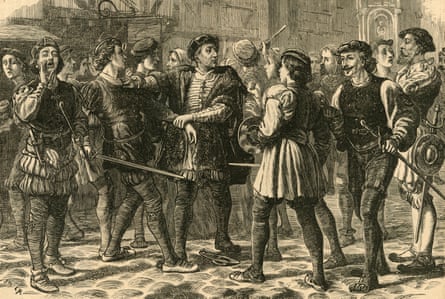
On 30 April 1517, the eve of the annual May Day festival, an angry crowd of more than 1,000 people marched through London protesting at the city’s immigrant population. Xenophobia was rife in Tudor England. Although foreigners, known as “strangers”, made up just 6% of the city’s population, they were often considered a malign presence: “Libertynes, drunkards, murderers, thieves and Conspirators,” in the words of one chronicler.
As darkness fell, the mood turned ugly. Thomas More, under-sheriff of London, appealed to the crowd to turn back. But his entreaties went unheard. The mob surged through the streets sacking the shops and houses of French, Italian and Flemish merchants and craftsmen. Only after an army was called out, leading to scores of arrests and over a dozen executions, was order returned.
Evil May Day, as the riot came to be known, was not quickly forgotten.
In 1591 a new play, Sir Thomas More, told the story of More’s rise and fall, from civic leader to Lord Chancellor under Henry VIII and his subsequent beheading for refusing to accept the king as head of the Church of England. The drama was written collaboratively by several authors. Most prominent among them was William Shakespeare, who revisited More’s encounter with the London mob. In Shakespeare’s telling, More successfully calms the crowd by making “the Strangers’ Case”, a passionate call for empathy in place of the “mountainish inhumanity” of hatred and bigotry.
Shakespeare’s scene still feels powerfully relevant. Not just due to the similarity between mob violence then and now, but because the Strangers’ Case is a reminder of how, for hundreds of years, artists have faced times of discord by asserting the value of our shared humanity. With that past in mind, the British Art Show asks: how does art today meet the fears of otherness and difference that emerge in a period of uncertainty and change?
Let’s reflect for a moment that the idea of the stranger describes a psychological as well as a social condition. Yes, the stranger denotes a feared outsider. But as the philosopher Julia Kristeva says, we are often “strangers to ourselves”, caught within the mysteries of our psyche. The stranger might be a repressed feeling or a memory that we struggle to acknowledge, its presence curdling our view of the world, turning others into projections of our own anxieties.
More and more, it feels as though, when we’re talking about the former, the stranger as outsider, what we’re actually referring to is the latter, the stranger as other, a feeling of unease and disequilibrium; a sense that the times are out of joint, and that instead of all the promises of wealth and ease that the future was supposed to bring, we find ourselves unmoored and lost. As the philosopher Marshall Berman wrote in All That Is Solid Melts into Air: The Experience of Modernity: “To be modern is to find ourselves in an environment that promises us adventure, power, joy, growth, transformation of ourselves and the world – and, at the same time, that threatens to destroy everything we have, everything we know, everything we are.”
You can hear echoes of that dread in public polling – seven in 10 people fear the UK is “on the wrong track”, according to More in Common’s 2025 Shattered Britain report – and in the despairing labels given by theorists to our current era, such as the New Dark Age and the Age of Unhingement.
Yet in uncertain times art can be a beacon. When we enter an exhibition, we leave behind the reductive thinking that only wants to see the world in terms of us versus them. We cross into a realm of complexity, contradiction and creative richness. We take on the point of view of an outsider, seeing the world anew with the eyes of a stranger. “When you are a stranger, you are both in and out. You are there but not really,” writes Ece Temelkuran in Nation of Strangers: Rebuilding Home in the 21st Century. The term stranger signifies “a pure form of curiosity”. It describes “those who are still not poisoned by the fear of the alien”. All those “to whom our time seems too strange to become complicit in its monstrosities”.
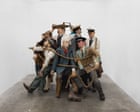
This sense of openness and discovery is shared by many of the artists in the British Art Show. For example, Accounts, a sculpture by Alex Margo Arden, ties together decommissioned male mannequins from the National Motor Museum with a thick length of rope. The work might gesture to deindustrialisation or exhausted ideas of masculinity.
But it’s hard to look at the men’s florid faces and side-parted hair, like bumptious extras from an Ealing comedy, and not also find something absurd and comic on show. This playfulness reflects Arden’s delight in the small, idiosyncratic private museums dotted around Britain: a favourite of hers is the Museum of Victorian Science in North Yorkshire which it boasts is “Ranked Number 1 Visitor Attraction in the Whitby Area!”. These venues collectively offer a folk history of Britain, based less on fact than storytelling, imagination and what Arden calls the “memories of memories”.
Mahtab Hussain’s film Here Is the Brick, made with writer Guy Gunaratne, tells a story of south Asian and Muslim life in Britain over the past half century through a feverish montage of anti-Muslim football chants, family VHS recordings, speeches by Islamophobic politicians, excerpts from old racist TV programmes, and coverage of the 2005 London suicide bombings. The title refers to a brick thrown through the window of an Asian-owned shop that struck the storekeeper in the face, breaking his teeth. Yet the film ends on an optimistic note with a stadium full of Liverpool fans singing in praise of Mo Salah: “If he scores another few, I’ll be a Muslim too.”
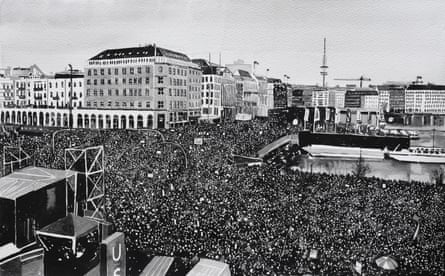
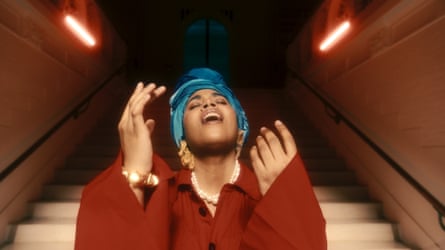
Other artists explore how we might claim a sense of agency within the disempowering structures of the modern world. In films by Melanie Manchot and Julianknxx, and in Joy Gerrard’s ink drawings of protesting crowds, there is dancing, singing, bodies surging on to the streets: a rejection of a status quo that is so often based on the subjection of the individual to the forces of capital; and an insistence instead on the value of gathering, of raising voices and moving or marching together.
Rather than an island separated by difference then, A Chorus of Strangers offers a hymn to possibility. Through the work of the participating artists, the exhibition finds abundant evidence that life might be richer, more wonderfully strange and strangely wonderful if, instead of heeding calls to division, we choose to look at the world through the eyes of others.
KioskNews shows a cleaned-up reading view extracted from the publisher’s page — the original always lives on their site, not ours.