UPI Payments Up To Rs 2,000 Are Free. Here's What Happens Beyond That
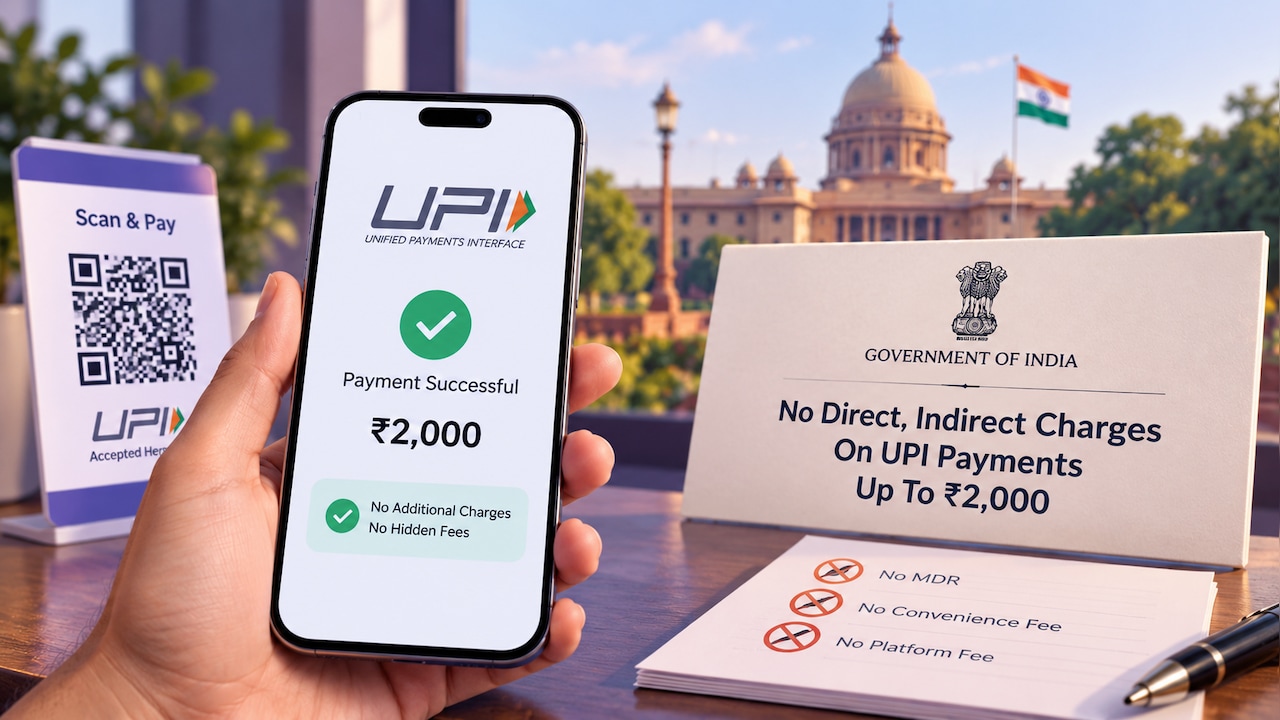
UPI Free Till Rs 2000, No Bank Can Charge: For millions of Indians, paying by UPI has become as routine. A quick scan, a PIN and the payment is done.
But recent discussions around UPI charges are raising a bigger question: could users eventually have to pay for making larger UPI payments?
On Monday, the government has now clarified one important part of the puzzle. UPI transactions of up to Rs 2,000 cannot attract any direct or indirect charge from banks or payment system providers.
Also Read | Layoffs Are Rising In Tech, But These Skills Are Helping People Unlock Better Pay
But what about a payment of Rs 2,500, Rs 5,000 or Rs 20,000? That is where the picture needs some explanation.
What Has The Government Actually Said?
The Finance Ministry, through a notification dated September 14, specified UPI transactions up to Rs 2,000 and RuPay-powered debit card payments as electronic modes on which banks and system providers cannot impose charges.
The notification specifically says that no bank or system provider can impose a charge, directly or indirectly, on a person making or receiving a payment through these specified modes.
This means a consumer making a UPI payment of Rs 2,000 does not have to worry about a transaction fee being added by the bank or payment system provider.
The same protection applies to payments made using RuPay debit cards.
So, Will UPI Payments Above Rs 2,000 Be Charged?
Not automatically. This is the part that could easily be misunderstood.
The government's latest notification does not say that a person making a UPI payment above Rs 2,000 will now have to pay a fee.
Instead, the recent changes to the Payment and Settlement Systems Act create the legal framework for introducing charges in certain cases.
The government had earlier indicated that any future Merchant Discount Rate, or MDR, would be limited to certain merchant transactions above a threshold. It has also said consumers making UPI payments will not face transaction charges.
In other words, Rs 2,000 is not a newly announced maximum limit for free UPI payments for consumers. There is currently no announced consumer fee that kicks in simply because a UPI payment crosses Rs 2,000.
Then Why Is Rs 2,000 Important?
The Rs 2,000 figure has become important because the government's latest notification specifically identifies UPI transactions up to that amount as a protected category.
The larger policy debate is about how the UPI ecosystem will pay for the infrastructure needed to handle its enormous and growing transaction volumes.
UPI has expanded at a remarkable pace. The number of banks live on UPI rose from 44 in FY2016-17 to 741 by July 2026, according to government data cited. Monthly UPI transactions reached a record 2,366 crore in July 2026.
The government has argued that the system needs a sustainable revenue model as spending on infrastructure, cybersecurity and fraud prevention rises.
That is where MDR comes into the picture.
What Is MDR And Who Could Pay It?
MDR, or Merchant Discount Rate, is a fee charged for processing a digital payment.
The discussion around UPI has focused on whether such a fee could be introduced for certain large merchants accepting higher-value UPI payments.
Government officials had indicated that any future MDR could be nominal and limited to selected merchant transactions above a threshold. Reports have put possible rates in the range of 0.25 per cent to 0.4 per cent, although no such rate has been notified in the government's latest notification.
If an MDR is introduced, it would be a charge on the merchant or payment ecosystem. It does not automatically mean that a customer paying Rs 5,000 through UPI will see an additional fee deducted from their bank account.
The government has repeatedly maintained that UPI will remain free for citizens.
What Should UPI Users Understand Right Now?
Paying Rs 500, Rs 1,500 or Rs 2,000 through UPI remains free for an ordinary person.
If you pay Rs 5,000 or Rs 10,000 through UPI, there is currently no government-announced consumer transaction fee that automatically applies just because the payment is above Rs 2,000.
What could change in the future is the way banks, payment companies and certain merchants recover the cost of processing larger transactions.
That is why the Rs 2,000 threshold should not be read as a new UPI spending limit. It is better understood as part of the government's new framework for deciding where digital payment charges can and cannot be imposed.
Offline UPI Is The Next Test Of India's Digital Payments Maturity
Meanwhile, offline UPI is also in the works. Shams Tabrej, CEO & Founder of Ezeepay, told NDTV, "UPI Tap & Pay can make digital payments more practical in situations where mobile internet connectivity is inconsistent. This matters a lot for people in Tier 2 & 3 cities & rural areas. In those places, the network is not always steady; this makes it hard to finish a digital payment."
From a financial inclusion point of view, these tools help because they cut down the steps needed. They are easier for shoppers and also for shop owners.
Tabrej added, "If a person can pay by tapping a phone and not wait for a working data connection, life is simpler. It also helps people feel more at ease with digital payments. The broader evolution of UPI is now not only about increasing transaction volumes but also about making digital payments more accessible across different connectivity conditions and use cases. For India's next phase of digital-payment adoption, reliability and ease of use will be as important as reach."
KioskNews shows a cleaned-up reading view extracted from the publisher’s page — the original always lives on their site, not ours.