Scientists get a new clue to the origin of solar wind 'switchbacks'
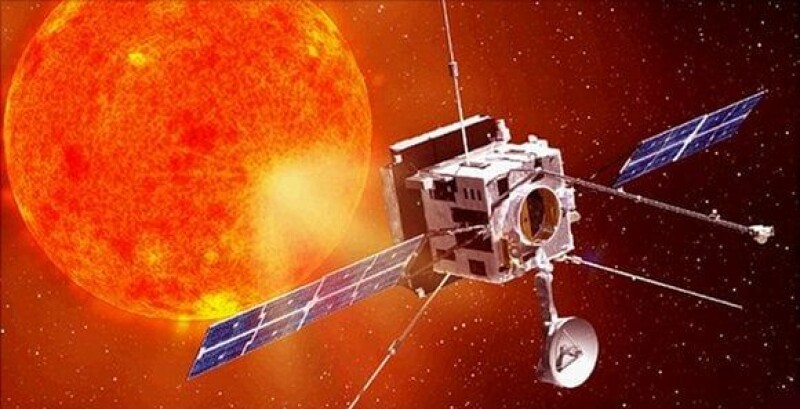
The European Space Agency's Solar Orbiter has enabled scientists to trace magnetic switchbacks in the solar wind's magnetic field back to their source at the Sun.
"Switchback" is the name given to an S-shaped kink in the solar wind's magnetic field – a sudden and large deflection. In 2022, the spacecraft gave scientists a full view of the structure (confirming the S-shape), but the origin remained up for debate. At the time, the probe's data suggested it might be near the Sun's surface, but a recent flight through a switchback allowed scientists to identify the source.
"Solar Orbiter flew through a very large switchback," said Jesse Coburn of the French National Center for Scientific Research / Laboratoire de Phonétique et Phonologie (CNRS/LPP. "Because of this, we were able to sample rarely observed particles there that have tell-tale fingerprints of their origin."
REG AD
Solar Orbiter's Solar Wind Analyser instrument (SWA) was used to sample the switchback's plasma, and it came up with particles that could only have formed within hot magnetic loops at the surface of the Sun.
REG AD
Coburn said, "There are two main competing theories for how a switchback, and by extension the solar wind, forms.
"The specific mix of particles detected by Solar Orbiter is the smoking gun for a formation process known as 'interchange reconnection'."
This occurs when parts of the Sun with different magnetic properties interact. Some have field lines that stretch away into space. Others are closed and extend into space before looping back. When the two types meet, the lines can snap open, releasing previously trapped plasma into space.
The other theory focuses on processes involving waves and turbulence.
Stephanie Yardley of Northumbria University in the UK said, "Excitingly, we also see signs of these, but likely only after the switchback heads out into space.
"Once the switchback has left the Sun, waves and turbulence take over and govern how it moves."
Data from NASA's Solar Dynamics Observatory was also stirred into the mix to reveal the switchback's solar source.
It's exciting stuff and shows how the Sun heats its atmosphere and accelerates solar wind particles into space. It also has implications for predicting solar storms and their severity.
REG AD
Daniel Müller, ESA Project Scientist for Solar Orbiter, said, "As humans on Earth – and in space – our lives are entangled with what's happening on our star. The solar wind ties the Earth to the Sun, and our understanding of its dynamics has key implications for how we keep our planet safe from extreme space weather events.
"The more we know, the better we can prepare for solar storms to protect our space-based infrastructure and technology." ®
KioskNews shows a cleaned-up reading view extracted from the publisher’s page — the original always lives on their site, not ours.