[Ask the Tax Whiz] The BIR sent an audit notice. What now?

- The Philippine Tax Whiz outlines how to respond to a Bureau of Internal Revenue (BIR) audit, emphasizing the importance of understanding taxpayer obligations and BIR examiner boundaries under Revenue Memorandum Order No. 22-2026.
- Taxpayers should verify the authority of audit notices, understand the rules regarding multiple audit notices for the same year, and comply with document submission deadlines to avoid penalties.
- Choosing a credible tax representative is crucial; taxpayers should ensure their representative's integrity and methods are sound, avoiding those who offer dubious guarantees or unofficial payments.
This is AI-generated. Read the article for full context. Report any errors.
Part 1 | [Ask the Tax Whiz] Why is the BIR auditing your business?
In the second installment of this three-part series, the Philippine Tax Whiz explains how to respond to a Bureau of Internal Revenue (BIR) audit, protect your rights, and choose a credible tax representative under Revenue Memorandum Order (RMO) No. 22-2026.
An audit notice arrives while you are managing payroll, serving customers, and keeping your business afloat. Where do you start?
RMO No. 22-2026 sets obligations for taxpayers and boundaries for BIR examiners. Understanding both helps reduce unnecessary costs and uncertainty—whether you run a small business or represent a multinational company.
1. Someone from the BIR wants to examine my records. What should I check first?
Check the authority: an electronic Letter of Authority (eLA), Tax Verification Notice (TVN), or Mission Order (MO), as applicable. These instruments serve different purposes.
For an eLA or TVN, verify your name, Tax Identification Number (TIN), taxable period, covered tax types, and assigned officers. The examination must stay within its authorized scope; expansion requires the appropriate authority. Raise discrepancies with the issuing office and keep a written record.
2. I already have an audit for the same year. Can the BIR issue another eLA?
The general rule is one eLA per taxable year, covering all applicable internal revenue taxes, subject to exceptions. Lawful replacement, consolidation, and continuation remain allowed.
A replacement eLA cannot expand the original scope, taxable period, or tax types. It must come with notice identifying the old authority and explaining its cancellation and the audit’s continuation. If another eLA covers the same year, ask how it relates to your existing case.
3. I am busy running my business. How quickly must I submit documents?
The eLA should come with the standard checklist and the taxpayer consent form covering the audit venue or authorized representative.
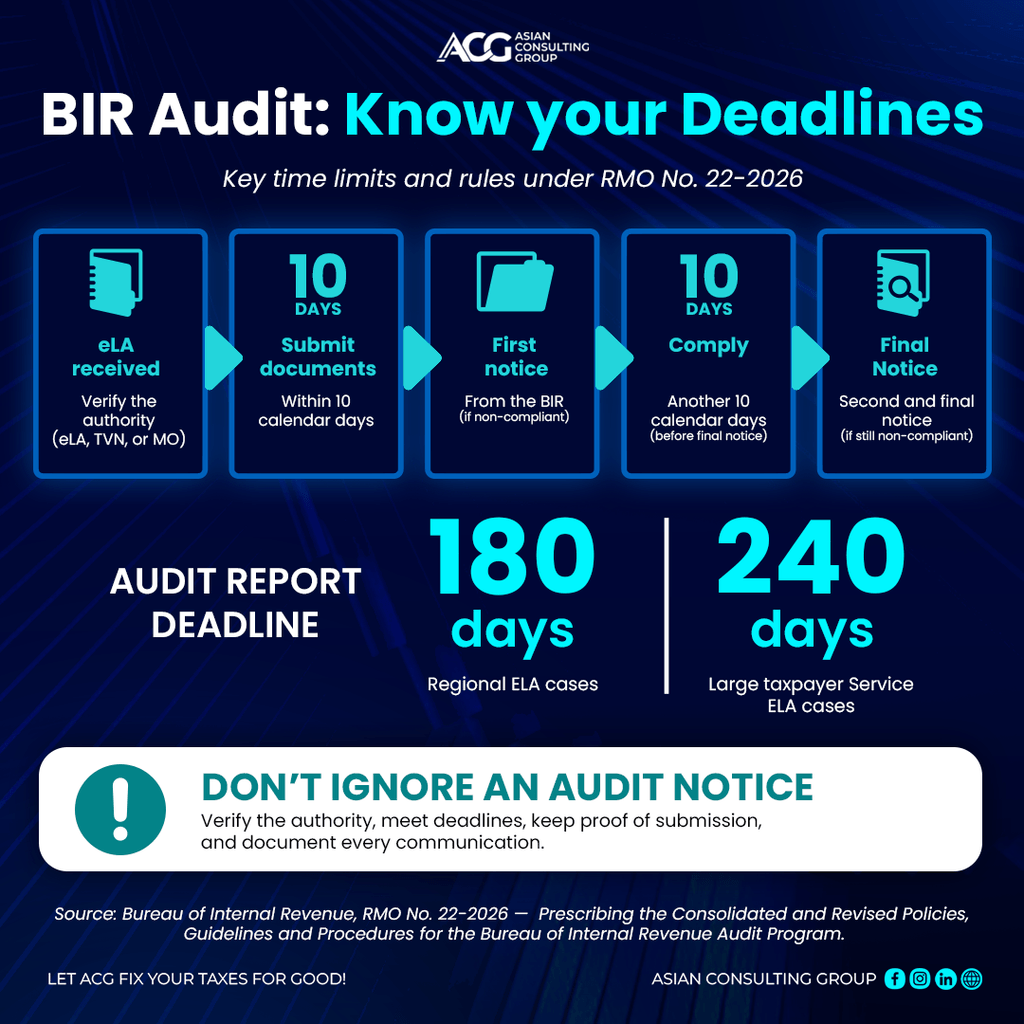
Failure to submit required documents within 10 calendar days warrants a first notice. Failure to comply within 10 calendar days from receiving that notice leads to a second and final notice.
Continued noncompliance can lead to a subpoena requiring production of records. Disobeying it can trigger criminal proceedings. Record receipt dates, organize the requirements immediately, and retain proof of submission.
4. Do I have to bring boxes of original records to the BIR office?
Not necessarily. Examination may take place at your registered business premises or the appropriate BIR office. Where transporting voluminous records would be impractical, burdensome, or disruptive, the order provides reasonable options through the consent form.
Certified photocopies may be accepted, although originals may be required for verification. Examination at your premises requires coordination and a suitable working area.
Once a valid subpoena is issued, however, records must be submitted to the BIR office it specifies.
5. How long should the audit take?
For eLA cases other than replacement eLAs, the prescribed report-submission periods are generally 180 calendar days for regional cases and 240 calendar days for Large Taxpayer Service cases, counted from the date of the eLA.
Other categories have different deadlines. Specified subpoena or exchange-of-information requests can suspend the clock.
These are reporting deadlines, not guaranteed closure dates. Missing them does not automatically invalidate an assessment, although administrative accountability may arise. Statutory prescription and due-process requirements still apply.
6. The examiner says I owe additional tax—or that everything is already “okay.” What should I get in writing?
For discrepancies, ask for the factual and legal basis and supporting computations. Check that the minutes of the discrepancy discussion accurately reflect your explanations before signing. Keep your submissions and track every notice, since preliminary and final assessments have different response procedures.
For paid cases or cases with no findings or discrepancies, the order requires a Termination Letter after approval of the audit reports, to be served within a reasonable time. Follow up for written closure rather than relying on verbal assurances.
7. How do I choose someone who can help resolve my BIR case without compromising my integrity?
Choose a representative whose credentials, reputation, and methods can withstand scrutiny. Ask who will handle your case, how findings will be challenged or resolved, what the fees cover, and how payments and case closure will be documented.
Be wary of anyone selling “connections,” guaranteeing a reduced assessment, or requesting unofficial payments. A credible adviser should explain your exposure, defend supportable positions, and pursue lawful remedies—including compromise settlement when legally available and properly approved.
Your representative’s conduct can put your business and reputation at risk. Resolving a case should never require bribery, fabricated records, or hidden arrangements.
For an initial assessment of your tax concerns and assistance needs, visit www.acg.ph or scan the accompanying QR code to accomplish a taxpayer profiling form. This helps identify the appropriate review or audit assistance; it does not guarantee a particular outcome.
A fair audit requires cooperation from taxpayers and accountability from examiners. Credible representation helps ensure that the process—and the resolution—can be supported by facts, law, and documentation. – Rappler.com
The third installment examines whether the new audit program can deliver fairer enforcement—and who holds the auditors accountable.
Mon Abrea, CPA, MBA, MPA (Harvard), is a global tax policy expert and Chief Tax Advisor of Asian Consulting Group (ACGlobal). He advises governments, multinational enterprises, and international organizations on tax policy, investment competitiveness, and fiscal reform. He is the author of Reimagining the World Without Corruption and Why Invest in the Philippines? CREATE MORE Edition, and has represented the Philippines in policy dialogues at the OECD, World Bank, and other international forums.
Below are some Ask the Tax Whiz columns related to this issue:
KioskNews shows a cleaned-up reading view extracted from the publisher’s page — the original always lives on their site, not ours.