‘My life is effectively destroyed’: Allison Inquiry exposes twin faces of fight against COVID vaccine policies
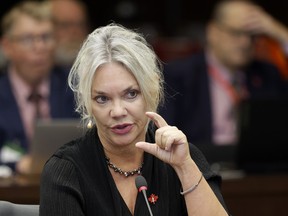
OTTAWA — Patricia Leidl arrived in Ottawa this week eager to tell a painful story about her reaction to the COVID-19 vaccine that even some of her own friends have questioned.
Sign In or Create an Account
After an uneventful first shot against the COVID virus, Leidl received a second dose of vaccine on June 10, 2021, just days before she was planning to head off to Vienna for a new job she couldn’t wait to start.
But seven days after that second vaccine, the Salt Spring Island, B.C. resident woke up in pain. Leidl got up and then collapsed. In the ensuing five years, Leidl told the Allison Inquiry into the effects of the COVID vaccines on Thursday, she hasn’t stopped suffering. Her list of conditions and symptoms is lengthy, many of which she says suggest neurological damage and chronic inflammation.
“My life is effectively destroyed,” she told National Post during an interview.
Despite her experience with the COVID vaccine, the former World Health Organization communications employee says she isn’t anti-vax.
Before offering her testimony to the MPs and senators, however, Leidl and dozens of others keen to share their stories of suffering and lost loved ones had to make their way past a lively protest assembled outside Ottawa’s Wellington Building.
The old downtown edifice, normally a site for parliamentary committee meetings and other staid events, became a second home this week for a few dozen protesters. Many believe that the COVID vaccines were part of a government plan to limit individual rights and gain further control and, in contrast to most of those providing testimonials inside, represent a different side of the dissent against the shots and the government’s pandemic policies.
Sporting a red ball cap that reads “Save Canada” with a giant, homemade hypodermic needle strapped across his shoulder, Howard Kwan says Canadians have bought into a massive coverup.
As he protested this week, Kwan said that the federal government worked with the pharmaceutical industry and others to convince Canadians that everybody needed to get the shot.
And since the pandemic faded, the Ottawa resident says, they’ve been trying to justify that effort and to hide the negative effects ever since.
The bigger picture government goal, Kwan says, is to rebuild society “in their own way.”
Kwan and a cohort of about 25 protesters who braved the rain Wednesday are among the thousands of Canadians who believe that the vaccination effort during the pandemic went too far, that the vaccine wasn’t safe, or that it was part of a full-blown government conspiracy.
While some have been galvanized by heated online chat, the Freedom Convoy trucker protests of 2022, and their shared concern about government overreach, these protesters are part of the very visible face of the fight against the government’s pandemic policies.
By contrast, Leidl, a former World Health Organization employee, is still not anti-vax.
A visual artist, writer and international development professional, she was in good health when she got her COVID shots, a non-smoker, light drinker and physically fit.
But in the days following her second shot, everything changed. Her symptoms include central nervous system pain, migraines, bi-lateral tendinopathy, arteriosclerosis, light sensitivity, tinnitus, chronic gastritis, and a heart rhythm problem called tachycardia. She has also lost the use of one of her ears, is in pain if she tries to sit or stand in one place for too long, and worries that she has deteriorating cognitive abilities.
Leidl, 64, said she hasn’t been able to work much during that period — including forfeiting the job in Austria — and has been put in “social exile” by some friends who have questioned her symptoms. She’s also spent about $250,000 over the last five years trying to get well.
For Leidl, unlike Kwan and most of the protesters in downtown Ottawa, her fight isn’t overtly political. She says she resents being labelled a “right-wing wingnut” because she’s suffering from vaccine injuries.
These twin faces of the battle against the government’s pandemic policies, or at least the effects of those policies, may have their differences. But they agree that Ottawa and the provinces should take responsibility for a vaccine that was rushed into millions of arms during a crisis and, to a degree, was mandated.
The vaccines were widely seen at the time as a medical miracle and the key to restoring normalcy after months of lockdowns and other restrictions. Canadians were immunized at record levels and in record time.
But that doesn’t change the fact that thousands of vaccine recipients were hurt — some in very serious ways.
Governments haven’t denied that the vaccines caused health problems, but have been tepid in deciding what to do.
Beyond the fact that a parliamentary committee is listening to experts and victims, Ottawa has also established the Vaccine Impact Assistance Program (VIAP), which provides financial support to Canadians who have suffered serious or long-term damage from a vaccine that was approved by Health Canada. The program, which began accepting applications in 2021 and is administered by the Public Health Agency of Canada, doesn’t assess blame, just whether it was likely that somebody was harmed by a vaccine.
Deanna McLeod, a medical researcher and founder of Toronto-based Kaleidoscope Strategies Inc., told this week’s inquiry that doctors’ rules changed during the pandemic so that patients’ health care was guided by the collective good, not that of the individual needs.
“Public health became the (companies’) marketing arm.”
The inquiry, scheduled to hear from its final witnesses on Friday, is largely in listening mode. It has no mandate to issue findings or rule on whether certain vaccines caused harm, but could refer questions to Parliament.
National Post
Our website is the place for the latest breaking news, exclusive scoops, longreads and provocative commentary. Please bookmark nationalpost.com and sign up for our daily newsletter, Posted, here.
Join the Conversation
This website uses cookies to personalize your content (including ads), and allows us to analyze our traffic. Read more about cookies here. By continuing to use our site, you agree to our Terms of Use and Privacy Policy.
KioskNews shows a cleaned-up reading view extracted from the publisher’s page — the original always lives on their site, not ours.